Dragon*Con 2010: Cold Arbor Speedplugging

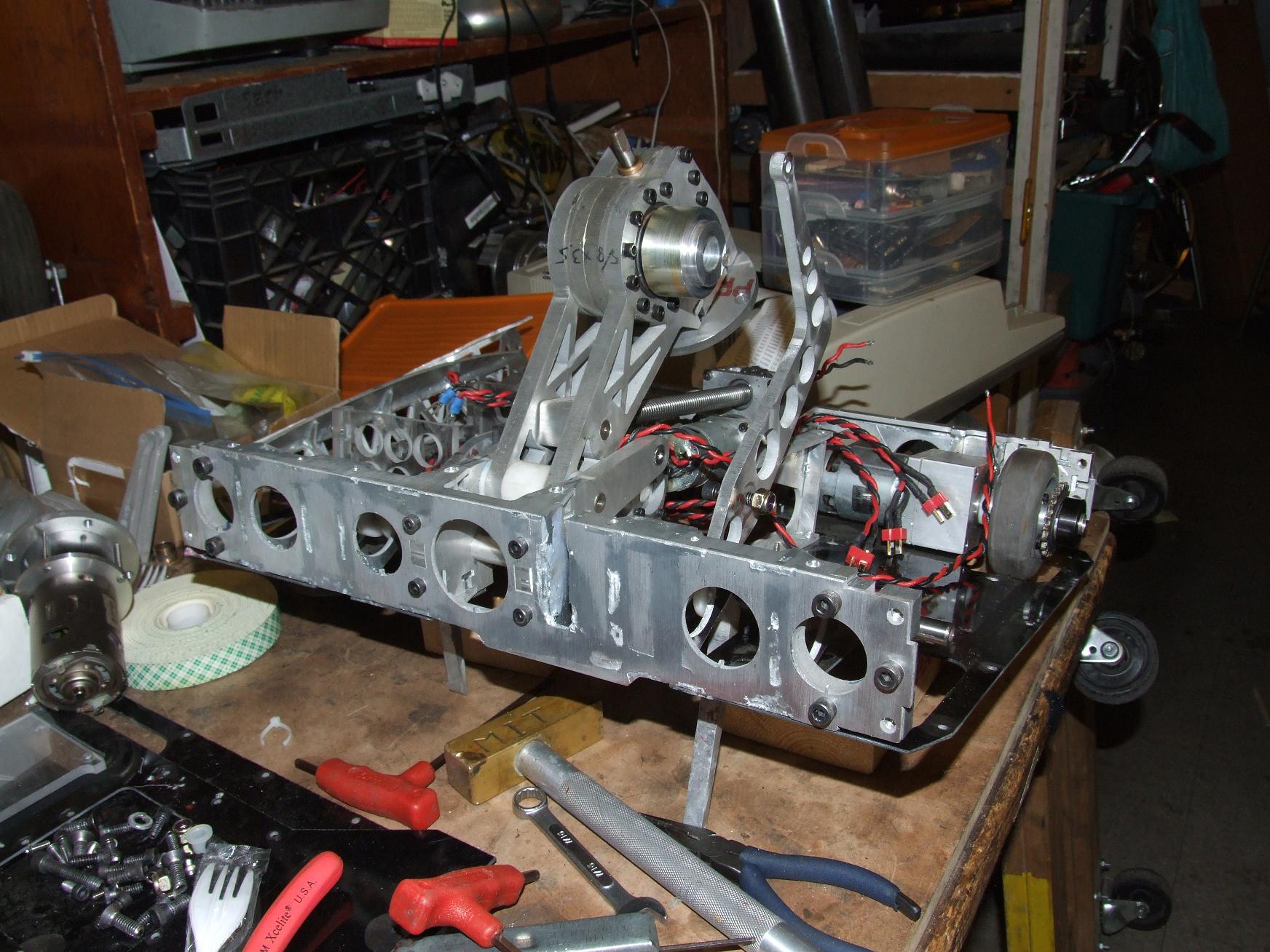
So there’s now a week left to go before the robots have to be packed up and shipped out. Nuclear Kitten is awaiting express-mailed parts from Hobbyking, and I’m just going to play it by ear in the time that remains. And now with Clocker done, I’ve primarily shifted efforts to Cold Arbor.  Arbor is actually most of the way ready to be reassembled. The grunge-machining, which has essentially been me making gearbox after gearbox, is finished. I now have to turn my attention to the front of the robot and appraise the condition of the brazed sheet metal assembly.

But first, pictures of gearbox after gearbox, because that’s apparently what I’m cut out to do in life.

Cold Arbor’s right drive gearbox was cannibalized for Überclocker during Motorama 2010. Arbor uses the now exceedingly rare (and expensive for) cheap drill gearbox with 700 size motors, so replacement parts for the intermediate stage are hard to find. Clocker promptly ate the second stage carrier, leaving me with no parts left to fix Arbor.

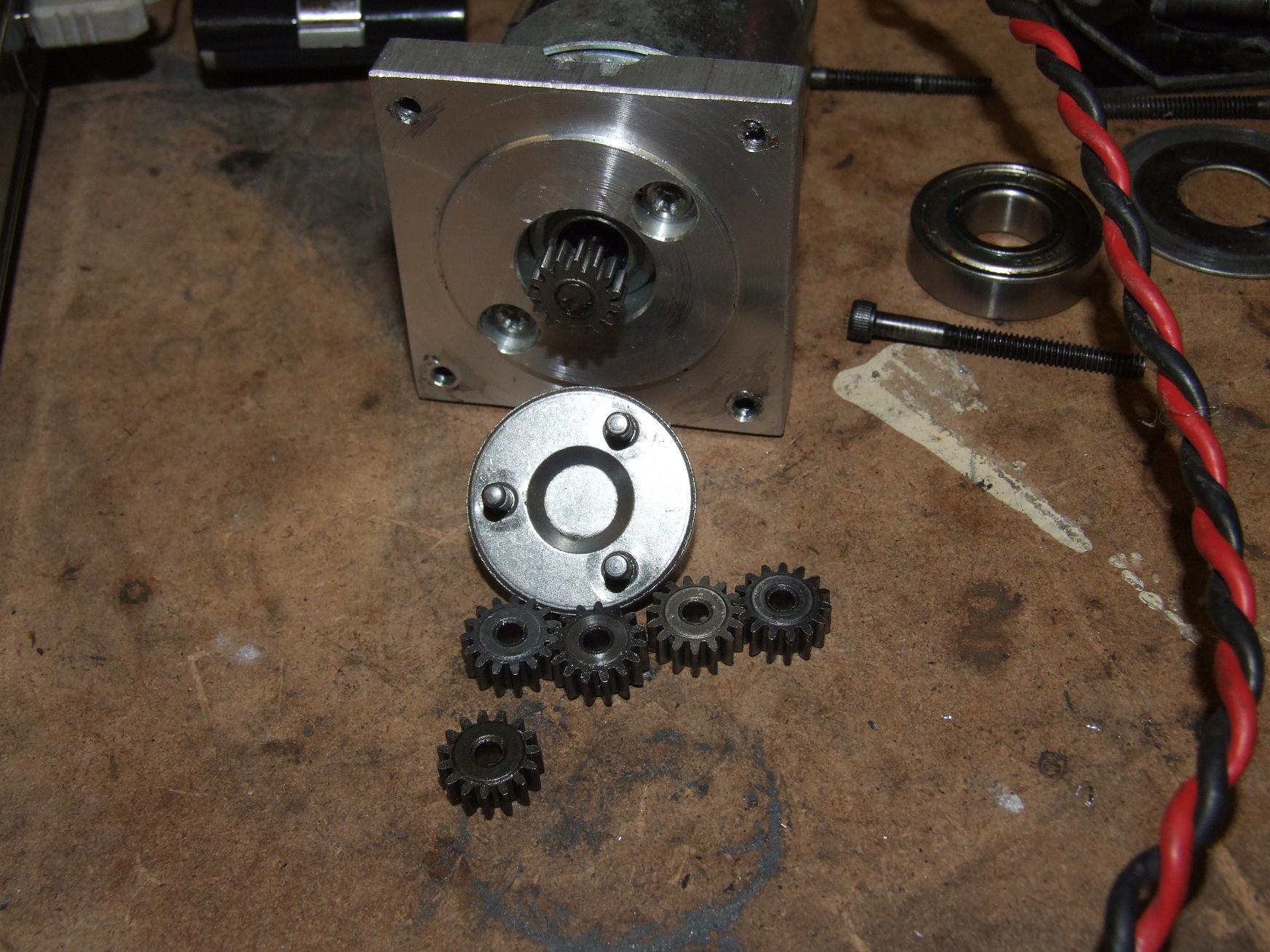
Or so I thought – while rummaging through my drill parts box, I started hitting 15 tooth gears, one after another. I figured I cannot have so many 15 tooth gears and not at least one more carrier plate. If I could find another carrier, then I wouldn’t have to remanufacture Arbor’s drives, and the whole bot could be put back together in 10 minutes.

I found a carrier which was wider than the others. Since the 15 tooth first stage has a wider planetary engagement circle than the standard 36:1 drills with 18 tooth first stage planets, I thought I had found the mythical lost carrier. Too bad, it was just a wider 18 tooth carrier.

I was not happy.

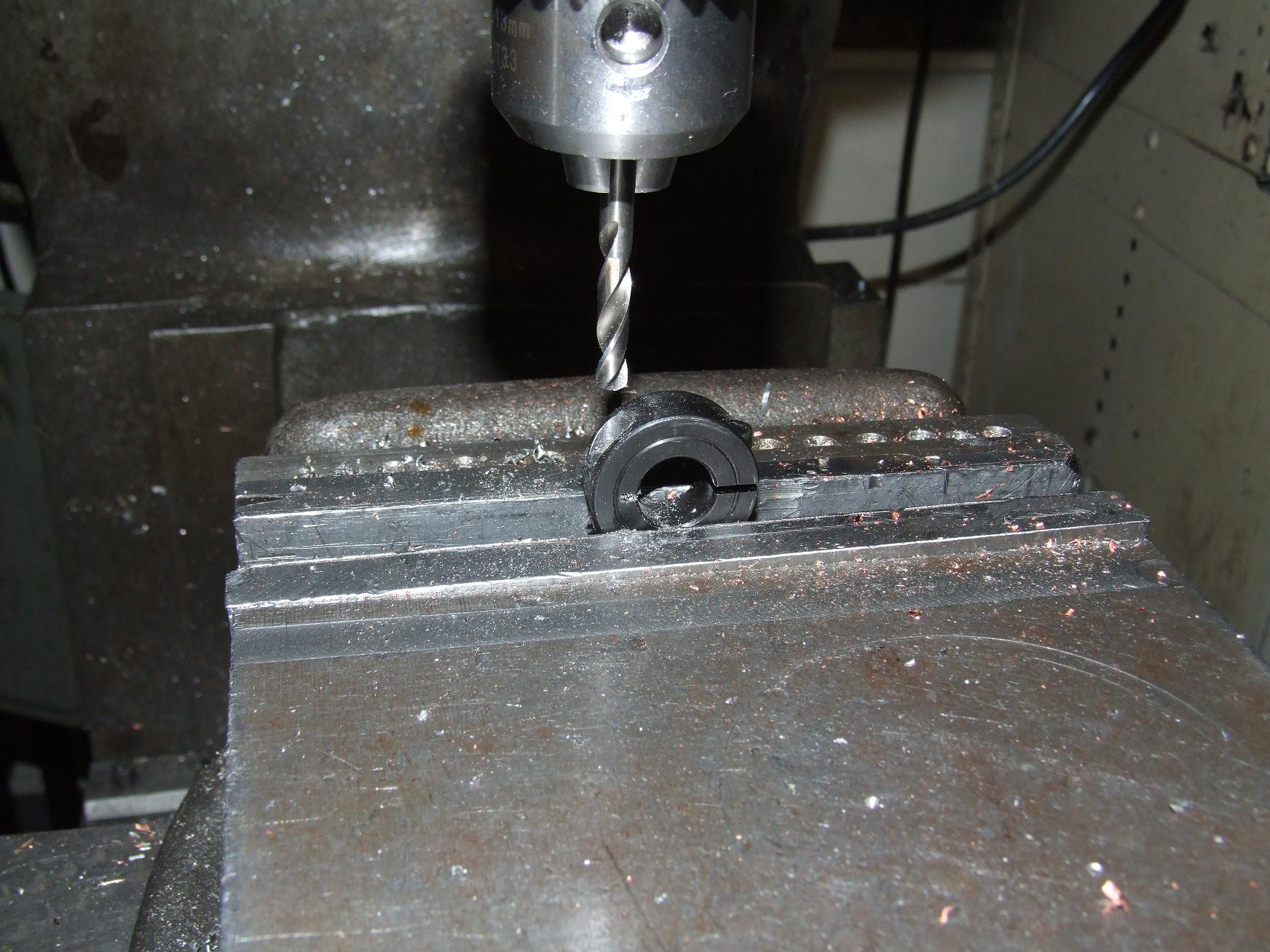
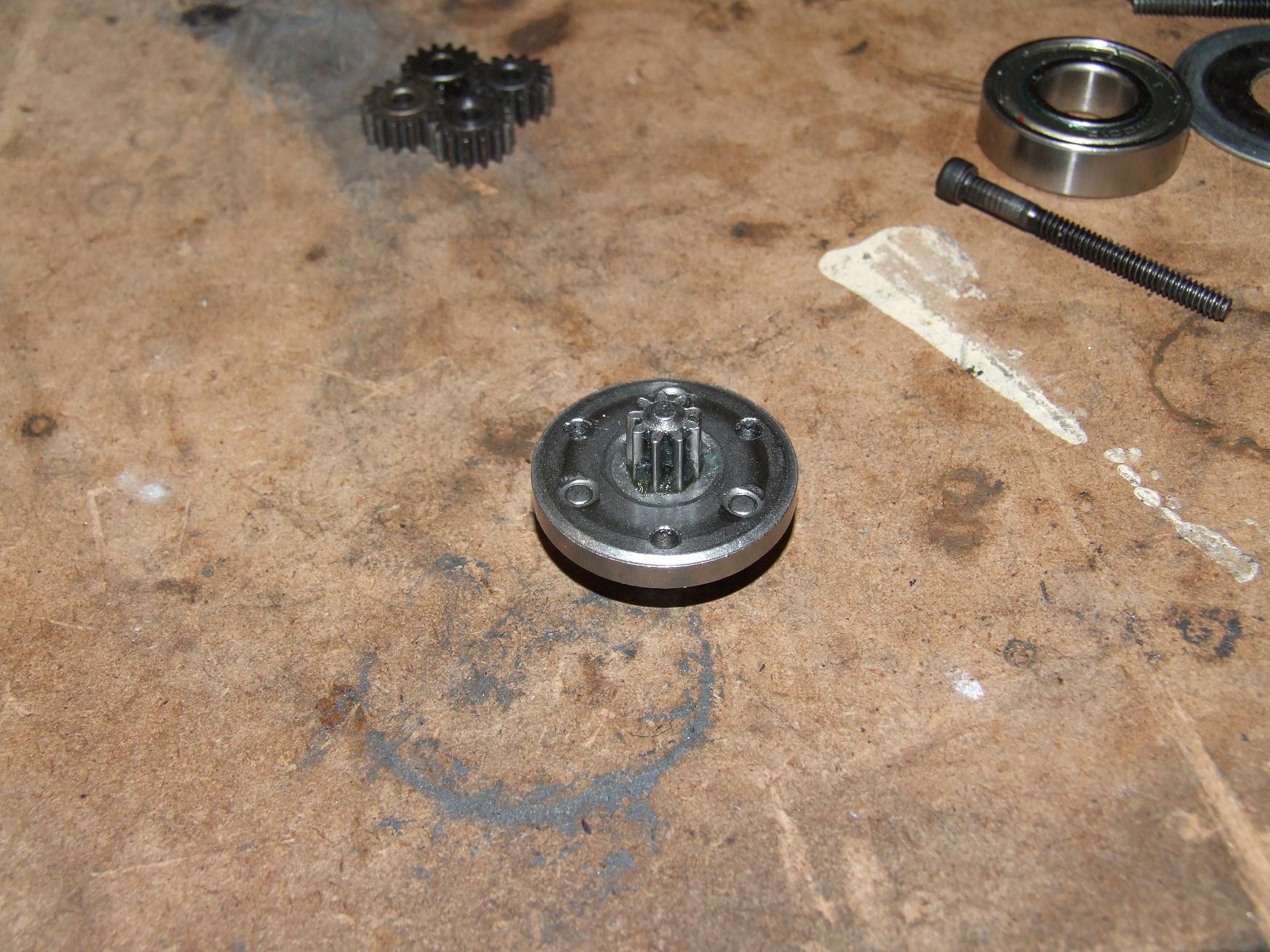
And I took my anger out on the carrier plate by… turning it into a 15 tooth carrier by drilling the damn pin circle into it. This was done on my haute usinage fixture, the rotary indexer.

Afterwards, I punched out the existing pins and moved them over into the new holes. This was actually a nontrivial exercise, since the pins were very small and demanded the straightest entry possible, something which I could not readily provide, even with a press.

After a bit of wiggling, the right gearbox is repaired. Why didn’t I just convert my carriers before?

I pumped the gearbox back full of grease, then threw it on the robot again. It will probably fail again during test driving, like everything else I build.

preduction

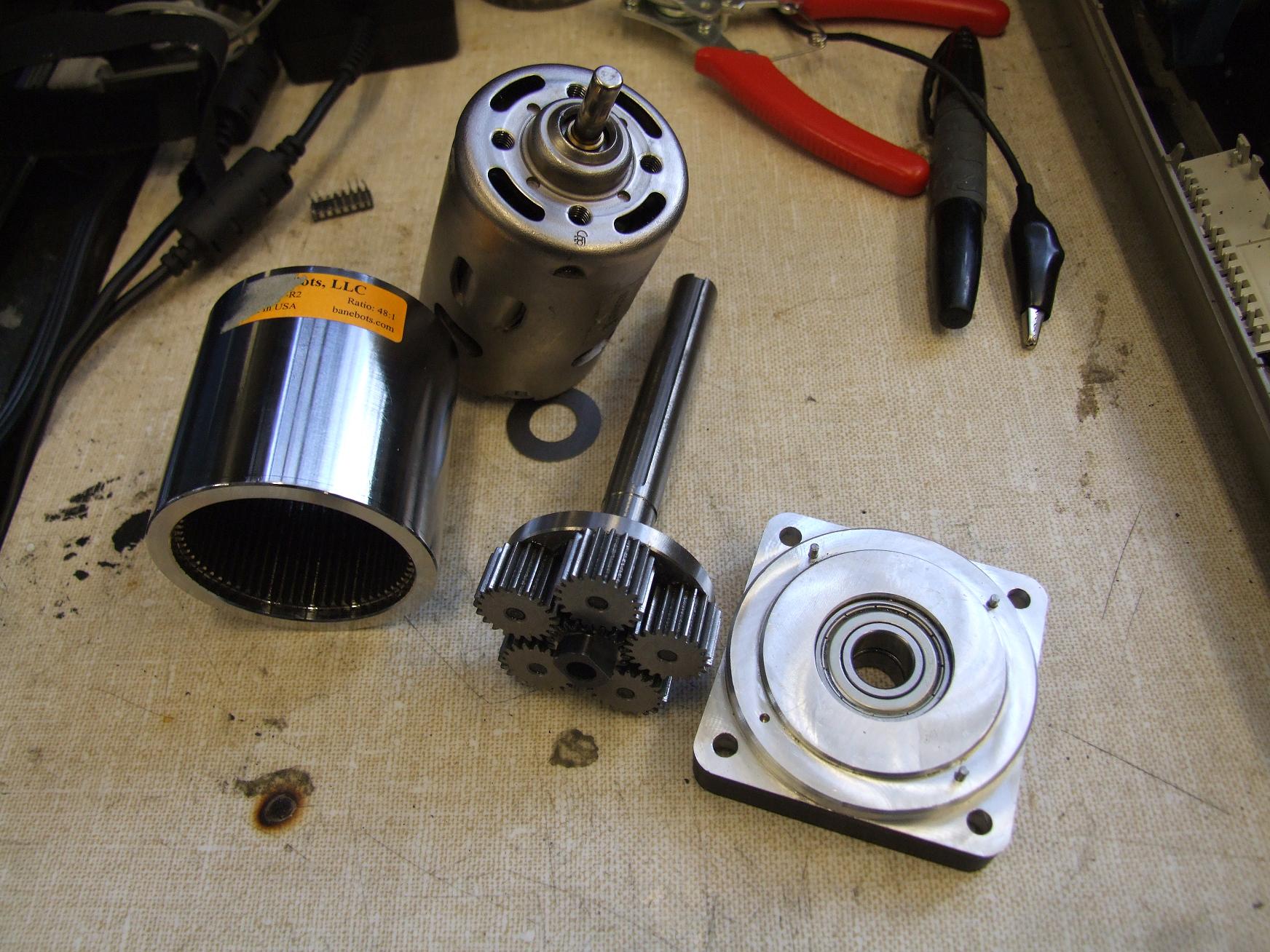
This is the junkyard parts-car equivalent of a Banebots P80 gearbox. Quite a long time ago, we bought one at the Media Lab to investigate planetary gearboxes for steering the embryonic Transformer that is the Citycar. It was experimentally determined that no, in fact, you cannot run a long Magmotor through this thing. And so it sat disassembled in a bag for the past few academic terms. Seasons passed and people graduated, and a few weeks ago I remembered that we had this thing and I needed a replacement for Deathrunner.

The motor pictured above is the Mini-EV-alike that I last remember seeing some time in 2007 before I left for the great northern wasteland. I guess I did end up bringing it with me. I literally have no numbers or performance data (or even a part number) on this motor, so I can only assume that it performs like a standard Mini EV. However, it’s a MEV with Magmotor-sized brushes, so it has to be more hardcore than the average MEV.

Regardless, I can’t have a 18-24,000 RPM motor feeding into the worm drive. So this is where the scrapped P80 comes in. I’m going to harvest one stage, the output shaft, and output carrier in order to make a 4:1 “preduction” gearbox for the motor.

There are three major machining steps in chopping and screwing the P80. The first is to cut down the ring gear so it’s sized for a single stage. It turns out that the ring gear is actually steel, and not brass or Shitluminum 9000­™ that the smaller Banebots gearboxes are made of.

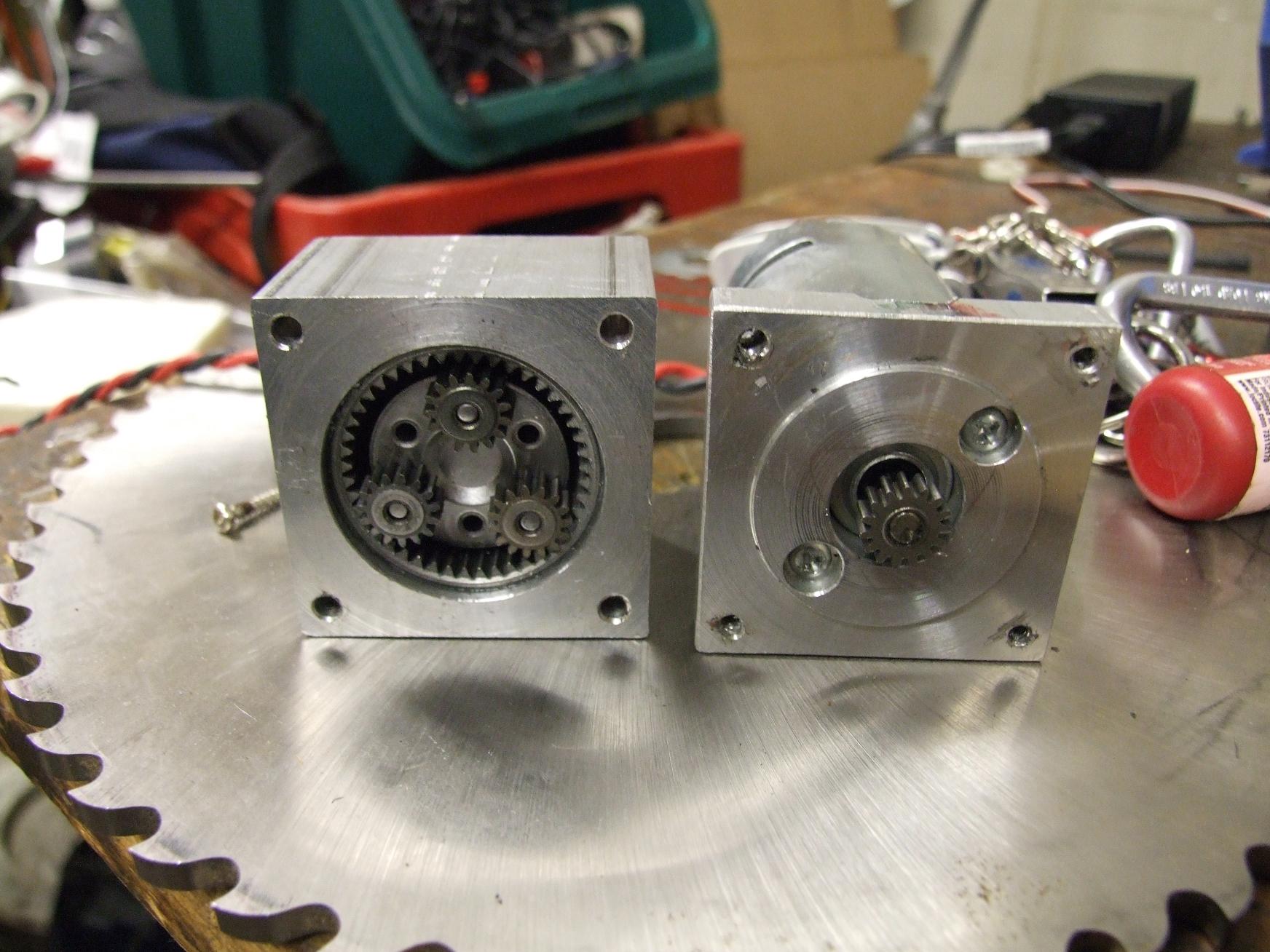
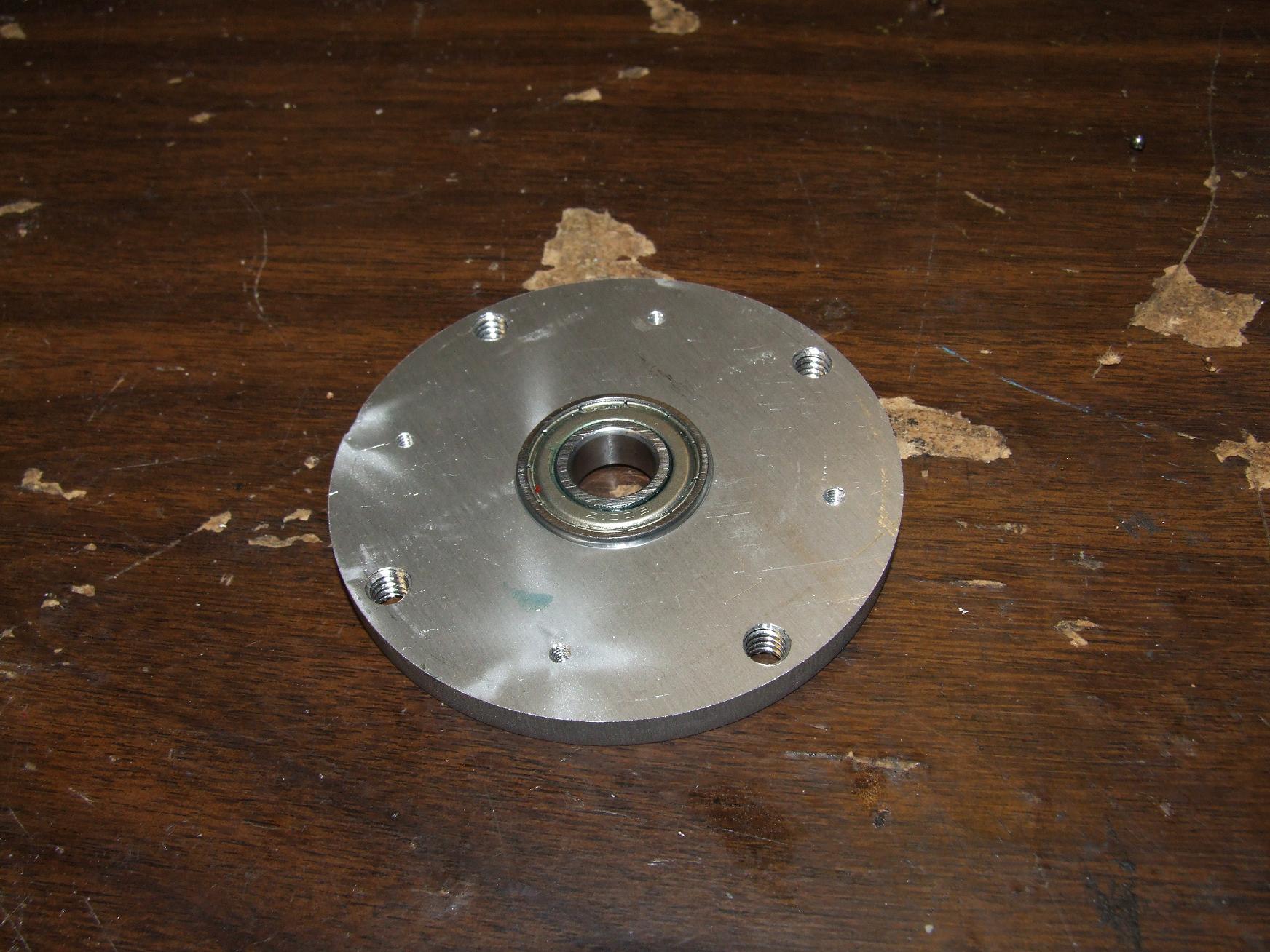
Next, I made the motor mounting plate using some 2.75″ diameter aluminum. The holes were processed on my indexer once more (which was conveniently zeroed in already from drilling the new drive carriers).

Finally, I bored out a spare 4:1 planet, which has the same number of teeth as the legitimate sun gear, to press on to the 6mm motor shaft. I used an “A” size drill bit, which had a nominal diameter of 0.234″, and just shoved it through the gear. Then I shoved the gear onto the motor with an arbor press.

Proper manufacturing of interference fits actually involves math and factors in material properties, thermal expansion coefficients, allowable stresses in the material, and some magic numbers. My method is to just shove with a bigger press.

The protruding motor shaft was ground down.

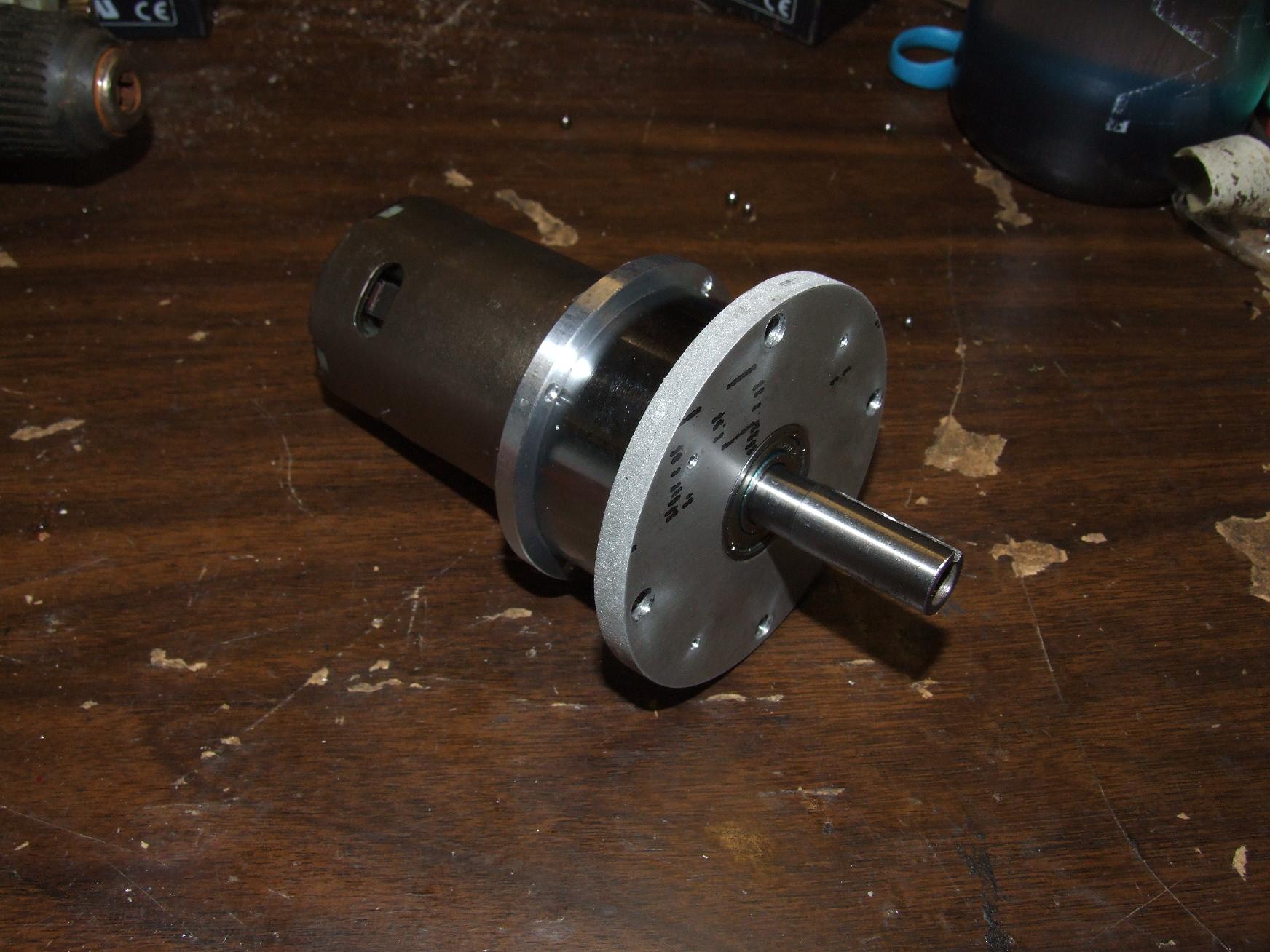
The front bearing carrier plate was a waterjetted protoform job. I originally specified double 6801 bearings, but I didn’t have any on hand and ordering some would take a week (or cost more than it should from McMaster). In lieu of double thin-section bearings, I elected to just hammer the 6001 medium-section bearing out of the stock P80 faceplate.

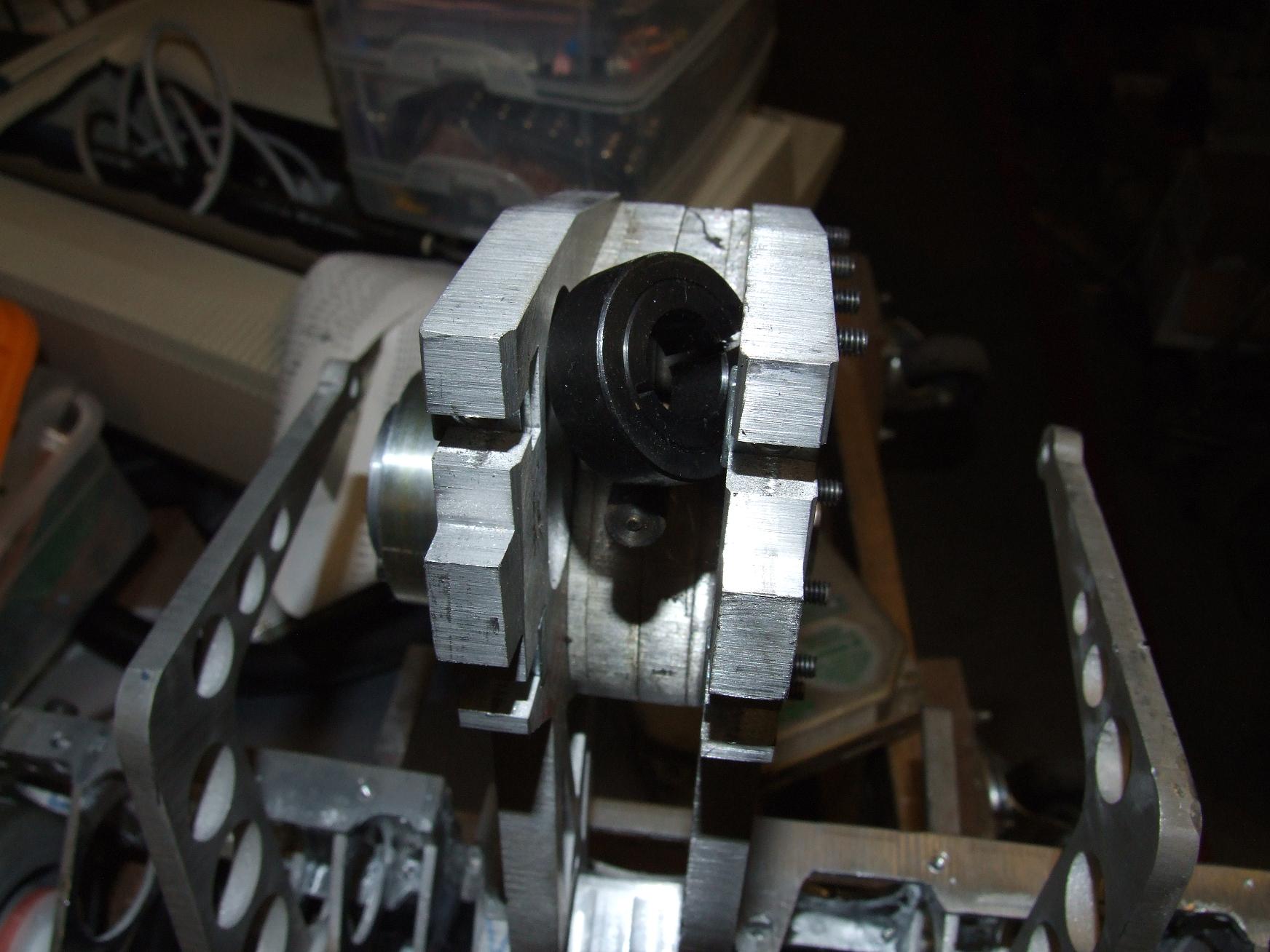
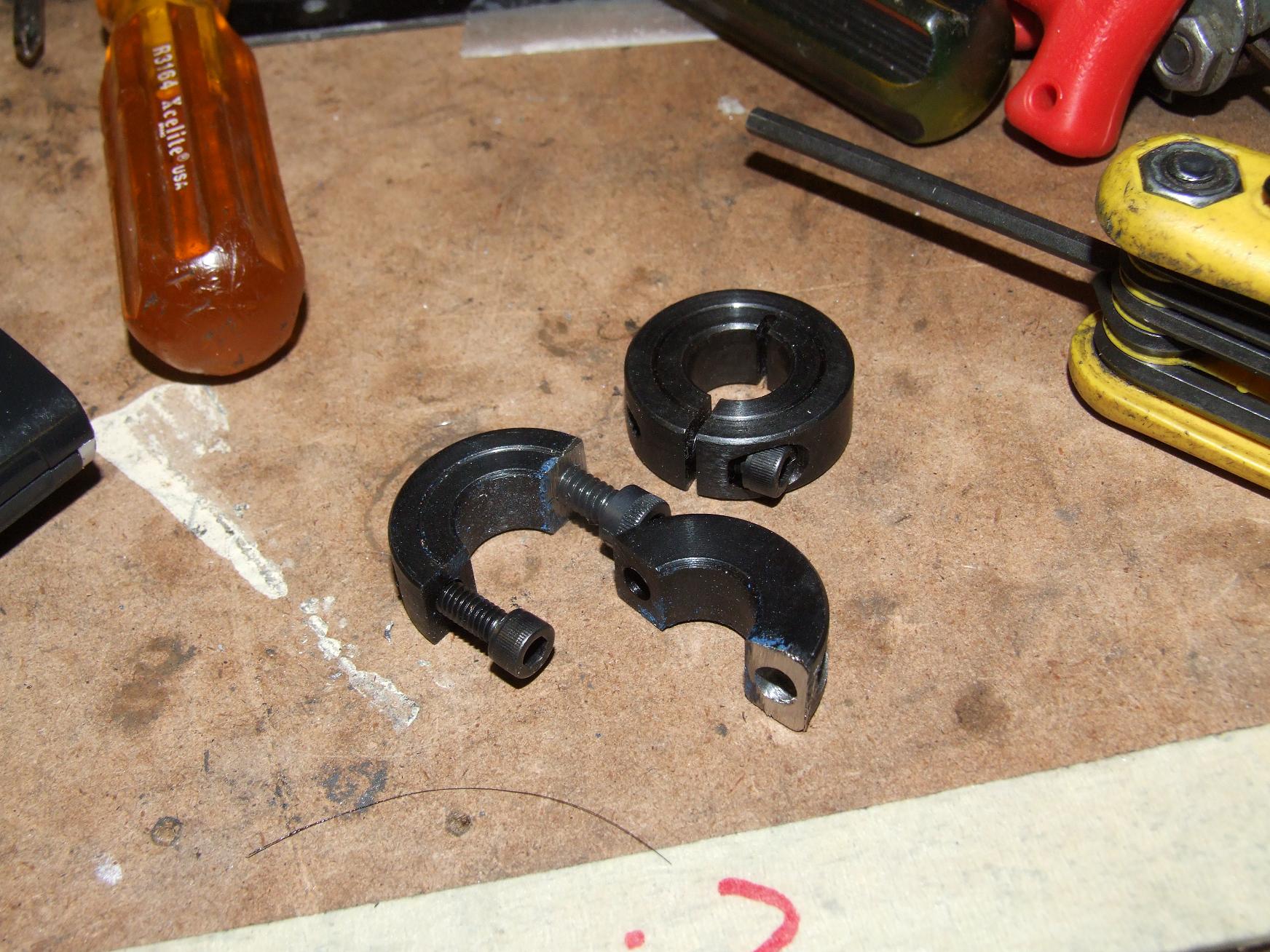
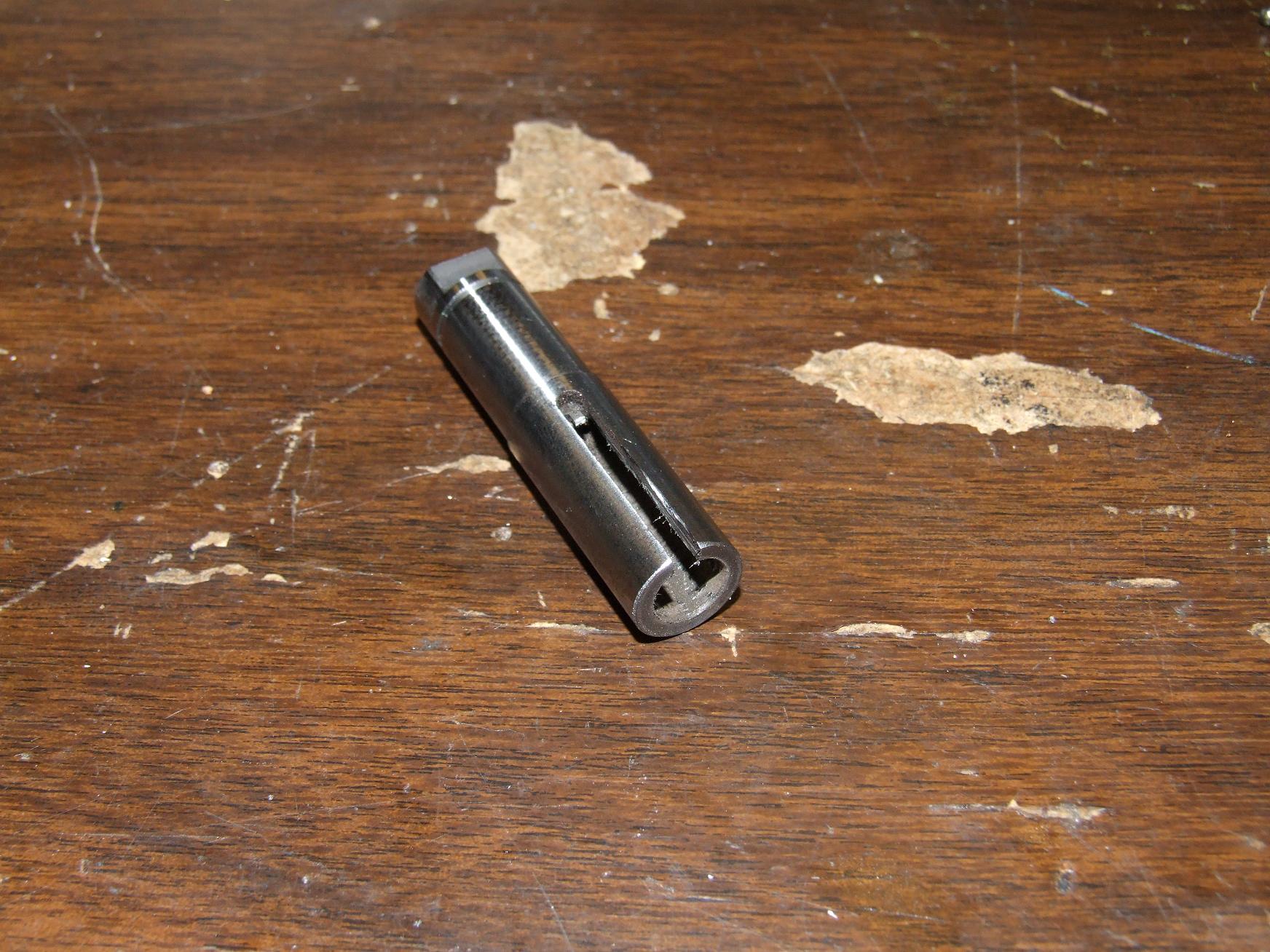
The P80 had a 1/2″ diameter shaft that I decided to take advantage of. I drilled the center of the shaft to 5/16″, enough to slip over the worm gear input. At that point, the bottom of the stock keyway in the shaft was a few hundredths of an inch away from breaking through to the internal bore, so I cut it out with a Dremel.

The result will be yet another clamp coupling, like Clocker’s former arm drive and my funky die holder. And Fankart!’s propellor mounts. I love these things too much.

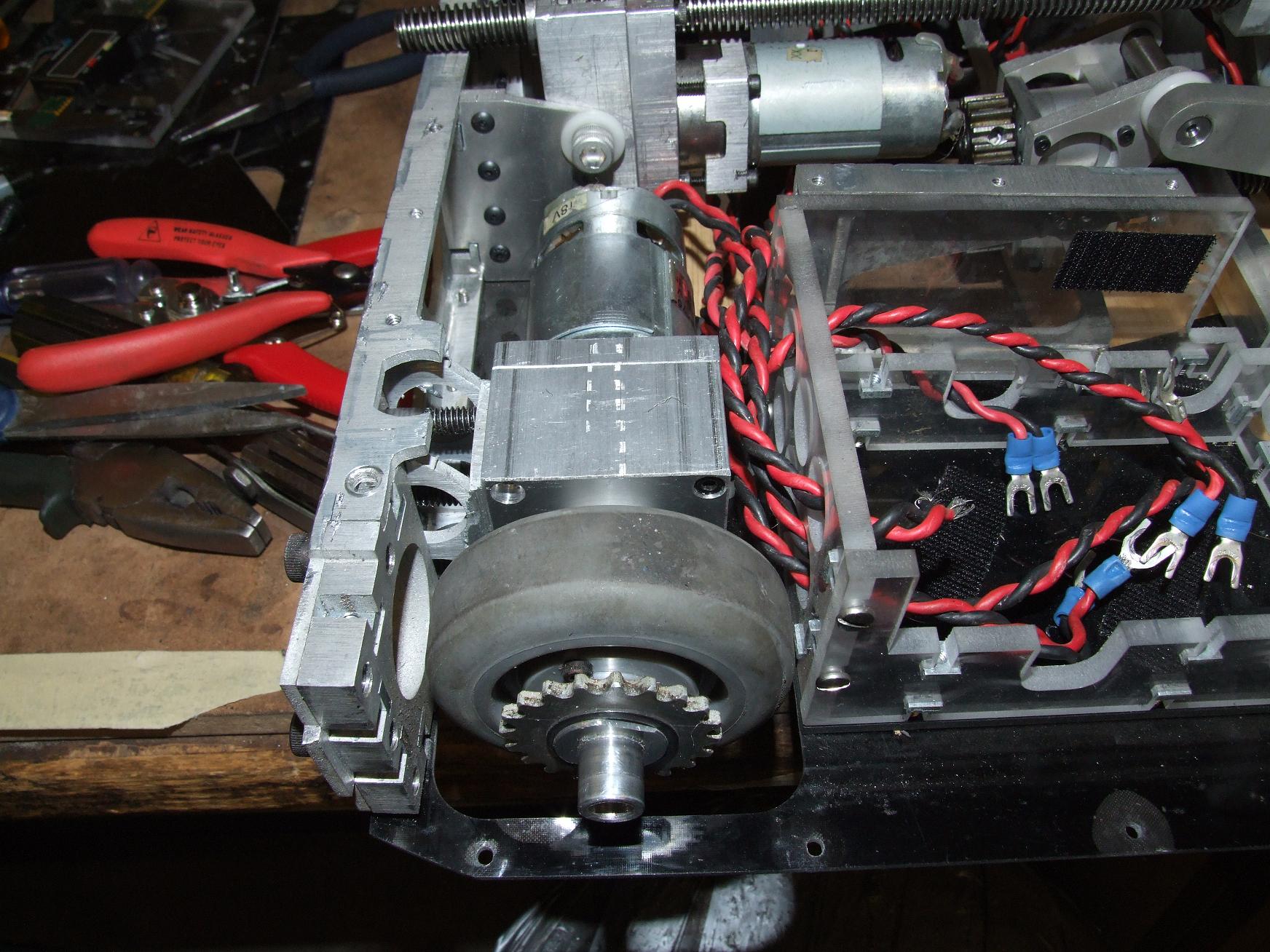
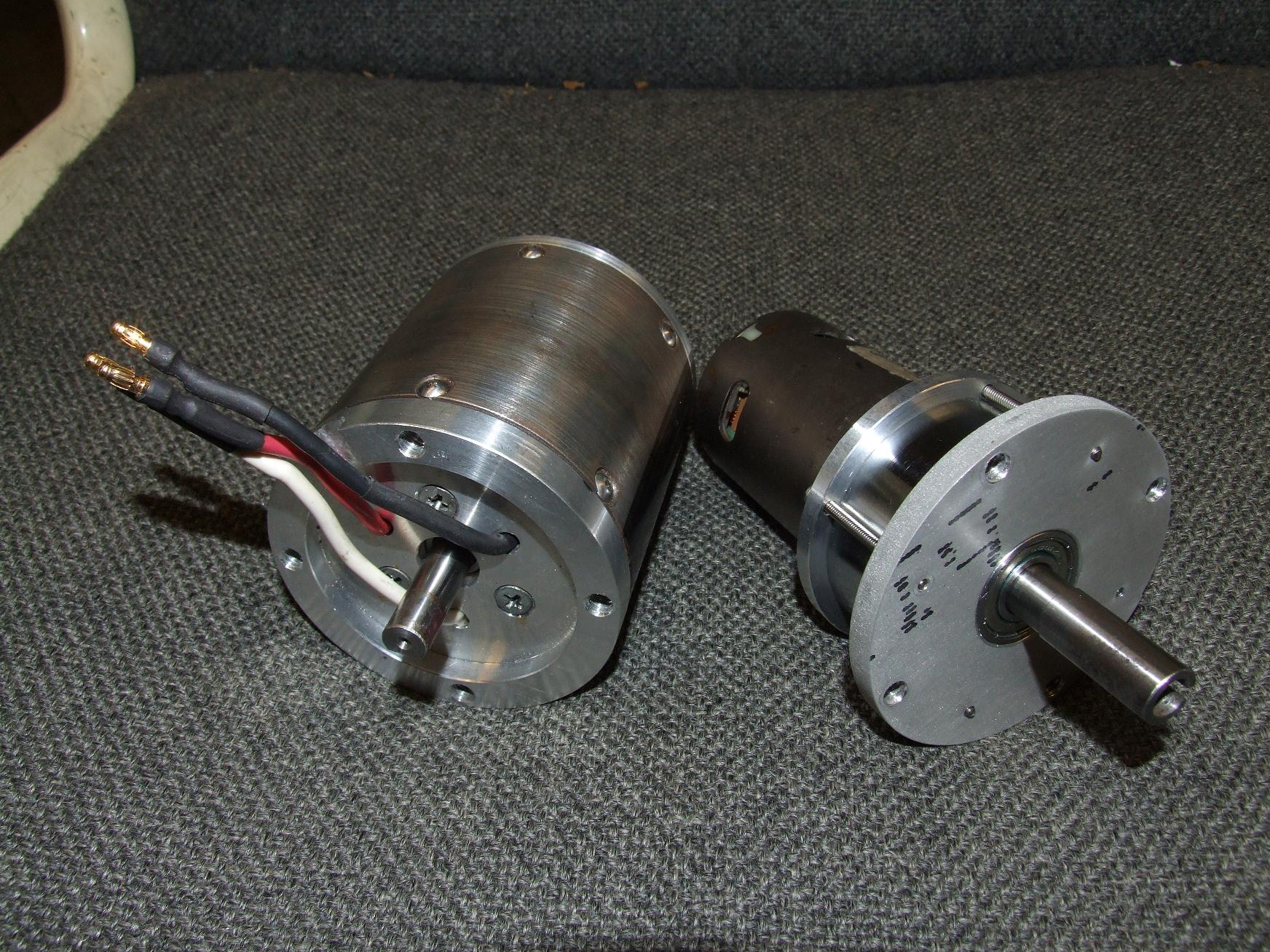
Here’s the Preduction drive, assembled but without hardware. I approve of how clean the whole assembly is.

Compared to Deathrunner, Preduction drive is about 1/2″ longer and unfortunately not that much lighter.

framing the issue

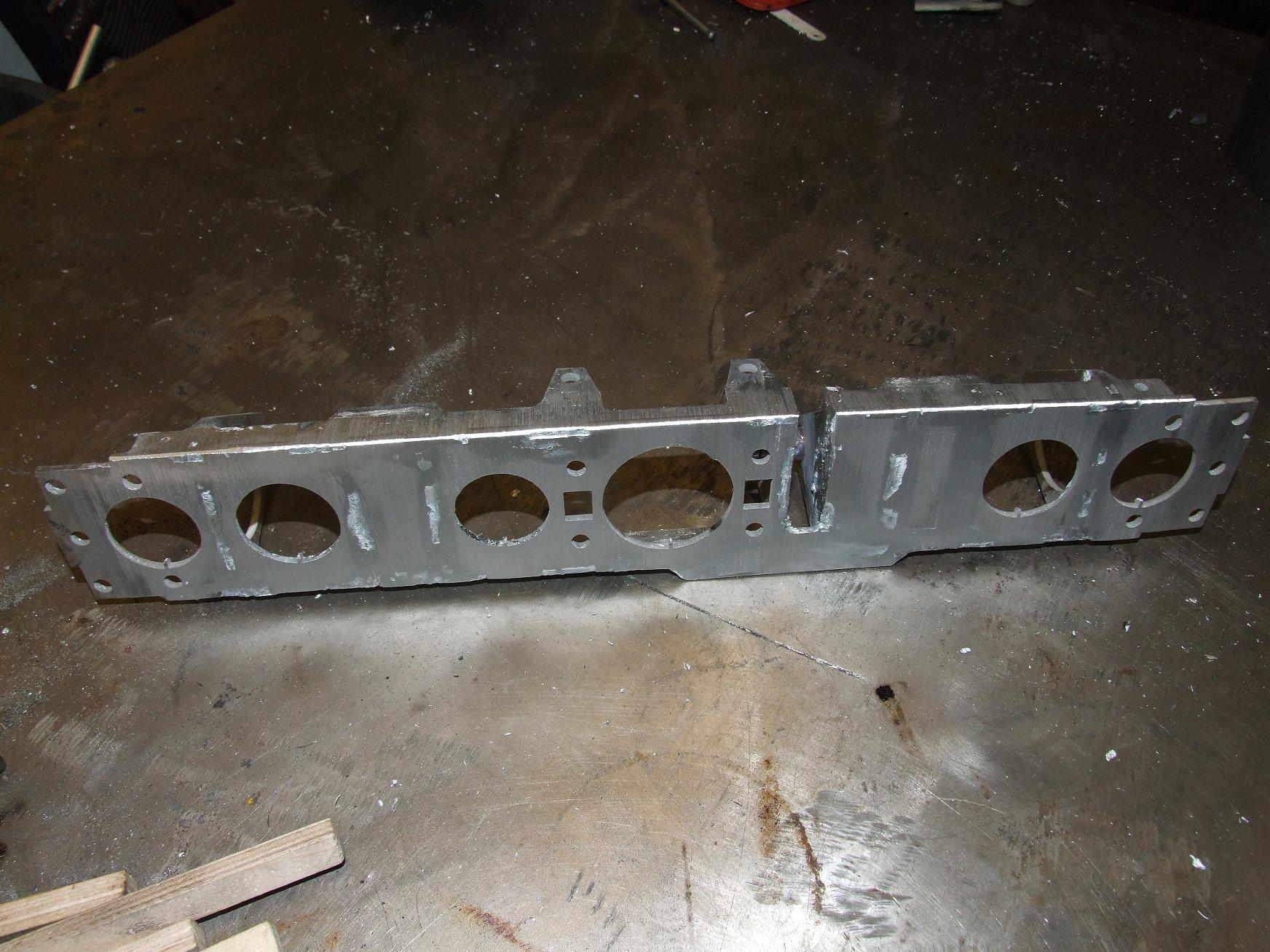
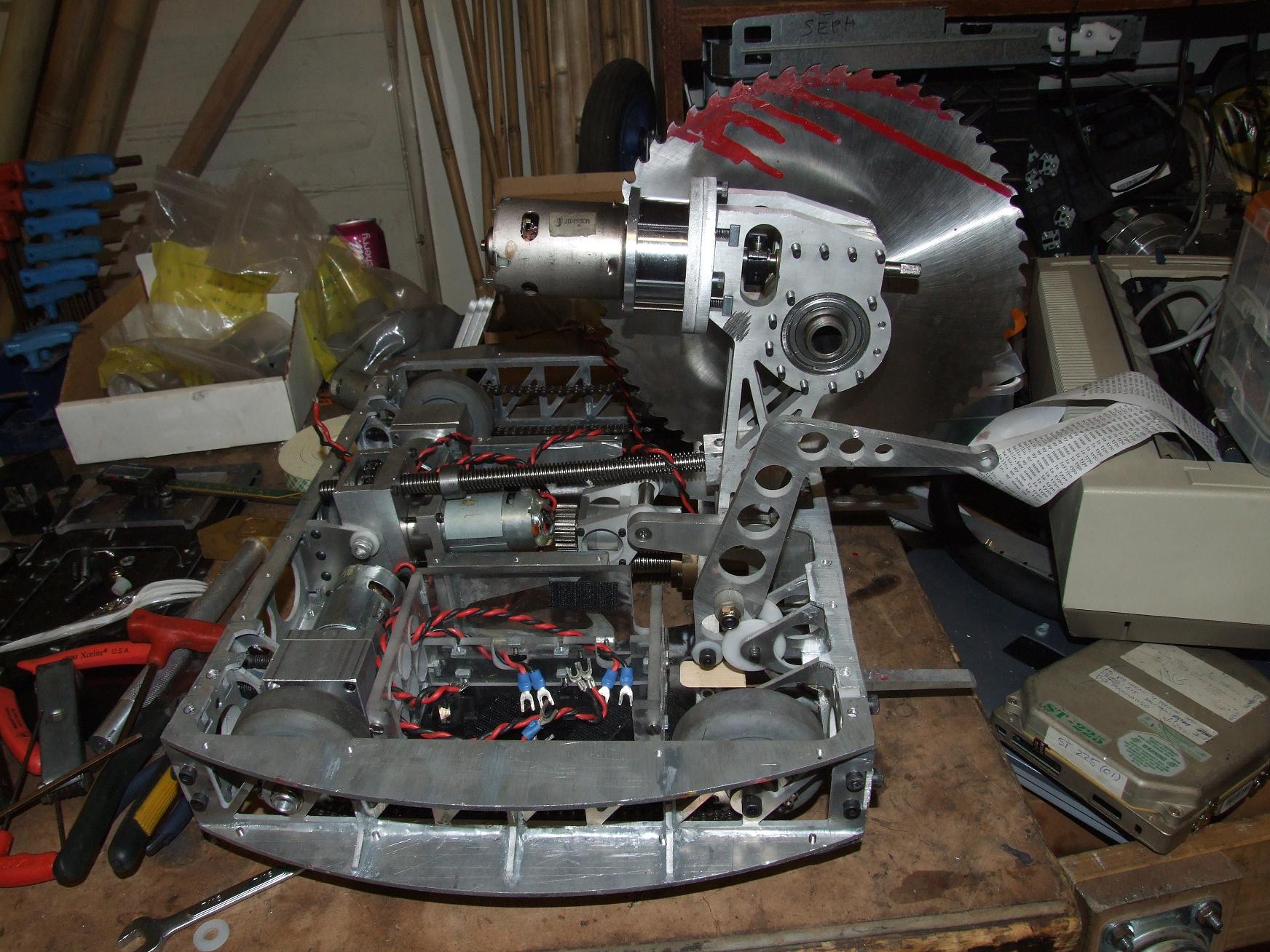
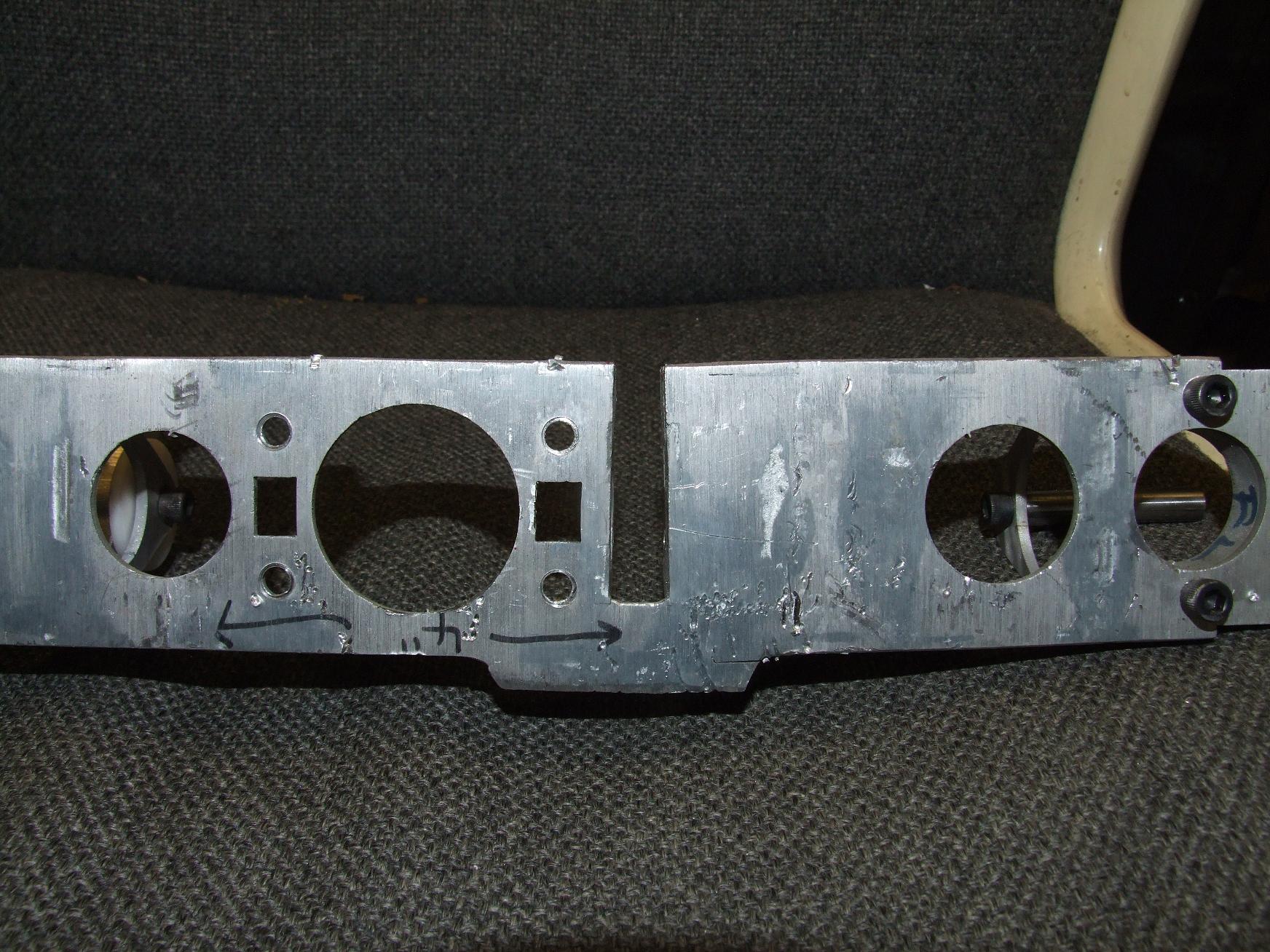
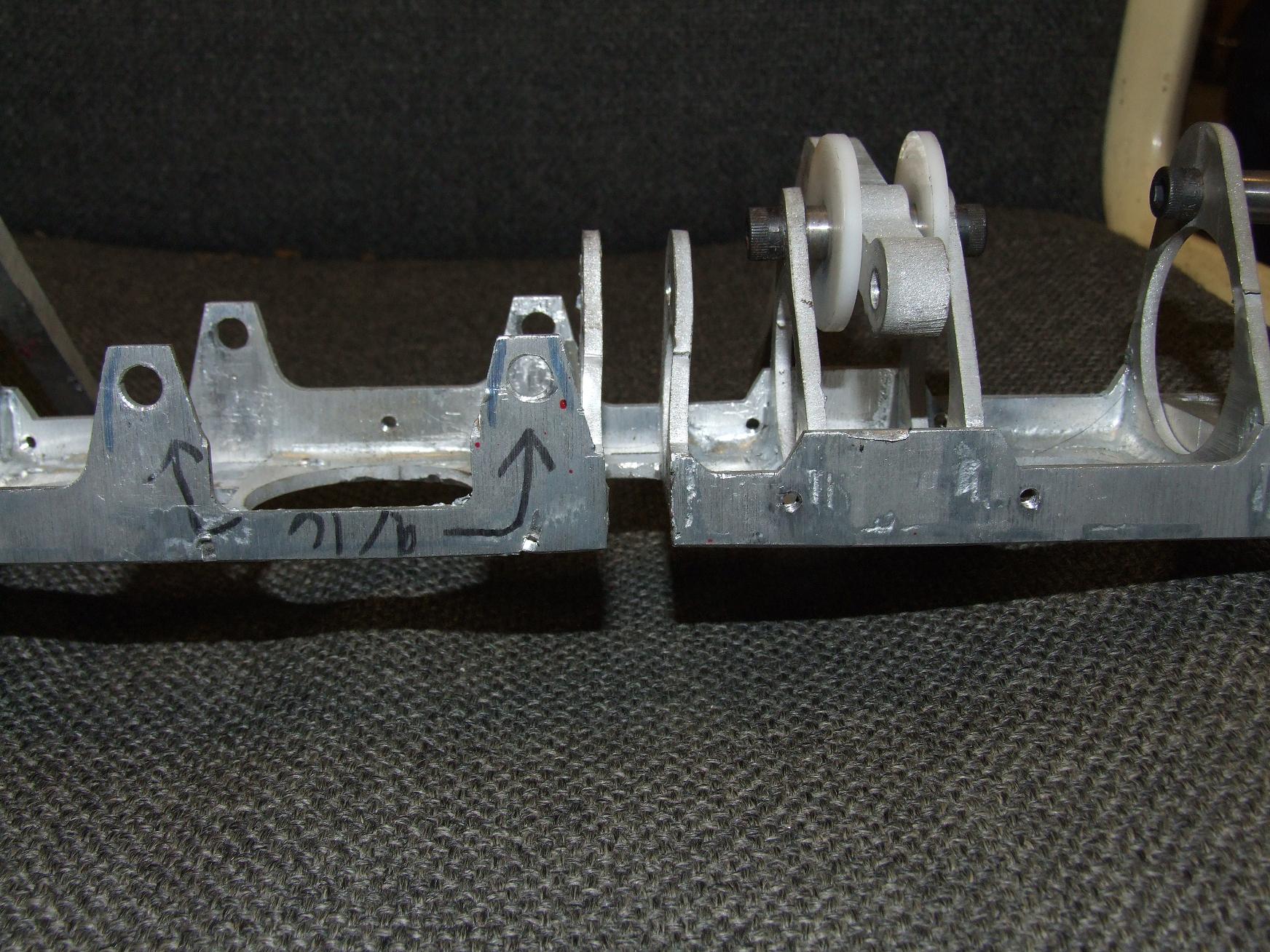
Here’s that “bent frame” issue that I described back during the first Cold Arbor situation sizing.  Essentially, this part of the frame is the most highly stressed point in the entire robot because of the thin cross section and its location right next to the saw mount.

Yet it’s also really poorly designed. My tabbing and slotting didn’t reach all the way across the gap, as the fracture failure on the lower right portion of the dropdown tells.

Additionally, where the saw connects on the other side, there’s huge weight-reduction holes. Thus, when this area inevitably experienced bending loads, the flanges just bent away.

Fail. I have a few front assembly cut out of 1/8″ aluminum that addresses both of these problems, so all I need to do is braze it together and throw every component back on.

Oh – there’s one more problem. The bottom fingers of each claw are attached using Impossible Standoffs – meaning standoffs which I threadlocked on both sides. Now, how the hell do I get those OUT?

Dragon*Con 2010: Überclocker is Done, Cold Arbor in the Mix, and the Nuclear Kitten 5.1 Blitz

In 2008, I had a Pre-Dragon*Con Botgasm. Last year, with only Überclocker, I didn’t have enough robots on deck to be finished in order to properly botgasm. Therefore, this year, I’m going to have to make up for it with now three bots that need completion!

Well, let me interrupt myself before I even start: Überclocker is done. I closed the bot up (well, minus battery cover, which I physically lost some time in the past 6 months) this afternoon and have been driving it around relentlessly trying to uncover hidden driveline mechanical flaws that could come and bite me in two weeks.  With Clocker asymptotically functional, I set it back up on the shelf and am now turning my attention to Cold Arbor…and a a revival of the Nuclear Kitten.

Überclocker

Two days ago, I left the FrankenWalt gearboxes about 95% finished. I made both gear cases, both sets of ring gears, both motor mounting plates, even both output stub-shafts… but only one output spindle. I just didn’t feel like machining the teeth off another gear that night.

But I returned later, having re-educated myself on the importance of finishing robots, and attacked that last remaining part.

Now here’s the reassembled drive base of the robot. I essentially took apart the entire outer metal structure, cleaned everything, then put it back together with the motors in place. Significant amounts of dirt, arena grunge, and metal chunks and flakes (!) made it into the corners of the robot, so as long as I had it in the open, I might as well clean it all out.

The outer chains have experienced some pretty serious stretching, and I expect that I’lll need to make a tensioner for them soon, lest they snag on something.

A couple more screw later, and the fork structure is remounted. While I had the fork apart, I took the time to make a few minor tune-ups and adjustments; mostly line items on the laundry list of upgrades that I keep intending to do (since they would technically take little time), but never get off my ass to do so. Such as:

…grinding the tips off the fork shaft set screws. These were formerly normal cup-pointed set screws, but I was dissatisfied with the way the cup point was gouging and digging into the flat on the (relatively) soft aluminum lifter shaft.

One way to resolve this is to just make a more legitimate power transmission medium, such as a keyed hub. But we can’t have that, since I’m lazy and therefore always vigilant for hackarounds. To obtain a wider contact surface with the aluminum shaft, I ground the tips off. Now, the contact circle is much closer to the 1/2″ screw diameter.

It won’t prevent gouging, but it should increase the shock torque handling ability of the fork a little more.

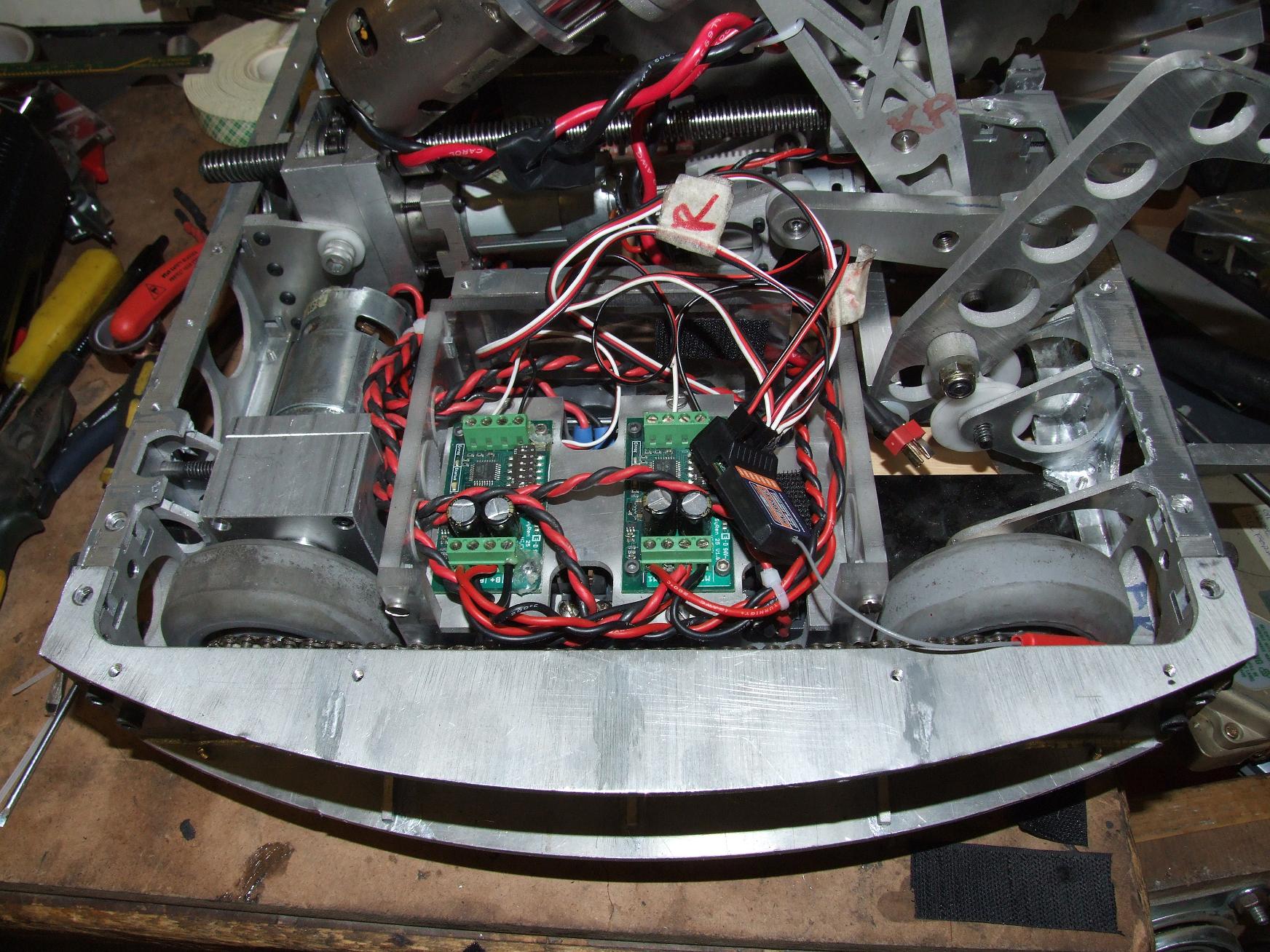
I kept the electronic bays intact, so dropping the Victors back in was a quick job. Since most of the wiring was on connectors, I didn’t have to rewire much from scratch.

Bonus: There is something very, very bad in the above picture. First one to name it wins….

… something. For what it’s worth, I fixed it.

A quick power-on confirms that the system is still functional.

Well, functional to the degree that I somehow managed to solder both drive motors in backwards.

Oh yeah – also on the list of stupid hacks I never get to is rearranging the actuator layout of the robot. Historically, Clocker has ran with the clamp actuator slung under the clamp arm itself. This location protected the motor itself from direct impact from opponents and also made the wiring path simple.

However, it severely constrained how far up the clamp could move, because the way the linkage is set up, the motor would just back itself into the aluminum fork hubs. This essentially limited Clocker to gripping opponents less than 8 inches tall.

I’ve toyed with the idea of flipping the actuator around so the motor is mounted above the clamp. This arrangement gains the bot another 2 or 3 inches of “grip” and also helps the leadscrew clear the truss that forms the forward portion of the clamp arm, which means the clamp can close to just over 1″ gap.

The only downside is that the motor is now open to damage. I’ll make an aluminum plate cover for it or something, but I think I’ll keep this setup.

All of this said and done, here’s some test driving video of Clocker, chasing Twitch, Jr. Everything goes well until the robots collide head on.

Hint: The robot that weighs three times as much and is essentially an uparmored Humvee in terms of structural durability fared better. Sorry Twitch :<

However, test driving revealed a critical flaw in the right side FrankenWalt – the first one I made. When I hard reverse planted Clocker into a corner, the right side completely lost coupling. I was completely unsure of what it could be, since the whole thing was made of Beast Fits and Loctite. As it turned out, the second stage ring gear’s press fit was in fact not a press fit at all. I probably only thought it was because I was pushing through burrs. The gear was actually pretty free to spin inside the gearcase. Solution: Drill down into the ring gear through the aluminum case just deep enough to insert a dowel pin. I used a #14  drill at 0.182″ diameter to make a gouge for a 3/16″ pin.

And by pin I mean lathe tool stock. Hey, it’s hardened steel and polished. Give me a break.

(The pin was cut flush with the gearbox surface and ground smooth, just for the record.)

It’s good that I found this out now and not, say, Monday morning of the con.

Overall, that does it for Clocker. I still need to cut out a replacement battery cover, since it being a nondescript cut-up-looking chunk of black plastic, it probably fell on the floor and got tossed during a shop sweep. At this point, Überclocker weighs 27 pounds – more than it did originally, but not surprising after the addition of the much bigger drive motors.

I’ll actually be making the replacement battery cover out of some very thick steel just to use up the last 3 pounds and push the robot’s CG back another millimeter.

cold arbor

Arbor has reached its own apex of entropy – after this point, I should be putting the robot back together more than taking it apart. Hopefully – I still haven’t addressed the drive motor issue yet. I kind of don’t want to make another two FrankenWalts, but I doubt I’ll be able to use the 24:1 gearboxes any more.

The designed parts of yesterweek have materialized into 1/4″ and 1/8″ aluminum plate. I managed to find a good deal on 2024 aluminum panels on eBay several weeks ago, and the 1/4″ parts here are made of that plate. Featured above are the new claws, the new saw motor mount, and new actuator mounting points for both front and rear actuators.

A little bit of sanding later and the rear actuator mount is in place. This is a very visible use of “thickness buffers” in the art and science of T-nutting. The original 1/4″ aluminum struts were 1.75″ apart, but the saw actuator is 2 inches. So between the back of the bot and the saw actuator, the spacing needed to widen up an eighth inch on each side and still had to hold T-nuts at the back.

So the solution is to stack two 1/8″ plates: one part which is purely a T-nut anchor, and another which is identical in that regard but also has the actuator mounting points – and make sure it’s on the outside of the stack.

The mounting plate is bolted to the thickness buffer plate using a handful of 6-32 cap screws. I thought about riveting it, but I couldn’t find our rivet gun.

The actuator drops in place like so. The only thing changing on this part of the robot is the leadscrew, which I’ll remake using a longer piece of Acme rod stock.

electr(on)ic mayhem

One of the downsides of possibly running two robots in the same class is that they might have to fight eachother in the tournament. If this happens, you either have to make sure you’re awesome at dual-joystick driving two robots at the same time, or have two radio transmitters.

I don’t. I only have my (outdated and obsolete) Spektrum DX6 radio. The same type that I ran back in 2007, when DSM1 was still in style. I have multiple BR6000 receivers for the transmitter, but only one Tx, and I don’t intend to get more obsolete equipment.

So what do I do? A real Spektrum rig is going to cost me another $2-300, which I could swing, but it would be kind of a waste of money given that term is about to start.

Luckily, like every other problem I have, Hobbyking has a solution.

On the left is my Spektrum DX6 (not even the i version). On the right is the HK-T6A 2.4Ghz 6 channel radio.

It costs all of $25, and includes a receiver. However, it also comes with no displays whatsoever (it’s the most bare-ass radio I’ve ever seen with more than 4 channels), no onboard switches for calibratoin, and the worst, buggiest we-made-this-with-a-trial-version-of-VB6 calibration software ever. Oh, and you can technically only get 5 of 6 channels working at any one time if you enable V-tail (& elevon, Delta wing, etc.) mixing for single-stick robot driving.

What it does have, though, is an established userbase and numerous “upgrade” hacks and replacement calibration software, such as Digital Radio.

The most important thing, though is that IT WORKS. For $25, I can deal with some shortcomings and rough edges. I’m tempted to tell Horizon Hobbies to just fuck off, but I also understand that HK is playing with alot of home field advantages, and would still spring for a real Spektrum rig any day.

The bottom line is that Arbor is getting its own radio for the con and for future events. This receiver setup has been determined to output “Bot-safe” signals i.e. none at all when the radio link is lost, so Arbor ought to still pass every failsafing test there is.

For what it’s worth, here’s a slightly junky shot of the inside. The difference for me between Chinese equipment and “established” well known manufacturers is that I never feel bad tearing into the former without even using it beforehand. Usually, I know that at least some kind of engineering has gone into the latter, and that me picking at it is only going to make things worse. So I satiate my curiosity on cheap parts and equipment.

The main MCU in the radio is an Intel 8051 knockoff that appears to share the same instruction set and pinout. Otherwise, the radio module itself is a bit more sophisticated, and features a 2.4G Taiwanese transceiver (Amicom A7105) and some kind of custom ASIC from Flysky (FS8004, which I can’t find a datasheet for anywhere).

My first mod to this radio is to make the left stick (throttle) spring-return to run the saw and clamp actuators. I didn’t have the correct part, but I chopped a spring lever out of a dead DX6 transmitter and sanded it down until it fit in the same slot. I also used the spring from the dead Tx.

There you have it – for $25, which is something like the cost of two burgers from Five Guys or how much Mountain Dew money I run through per week, you can get a 2.4Ghz 5.2387 channel radio that is essentially intereference-free, does not require channel crystal diggling, and has all the features you might need to control a basic robot. A word to robot n00bs: it did not use to be this easy. Get building.

nuclear kitten 5.1 surround sound edition

It’s back!

NK5 has been sitting idle on my robot shelf since Dragon*Con 2008 after it was first built. I’ve practically not looked at it, since I assumed it had taken significant damage at DC08 and was essentially not worth repairing.

After some egging by friends, I found out that I was pretty wrong.

Here’s the robot after I stripped everything down to prepare for rework. The overall appraisal:

  • The two drive gearboxes I thought were destroyed are actually working fine. No stripping or weird noises
  • The motor is functional, doesn’t have crunched bearings, or shorts in the windings. It just needs some magnets replaced.
  • The weapon pod swingarm is pretty heavily damaged and will need rebuilding to a beefier specification.
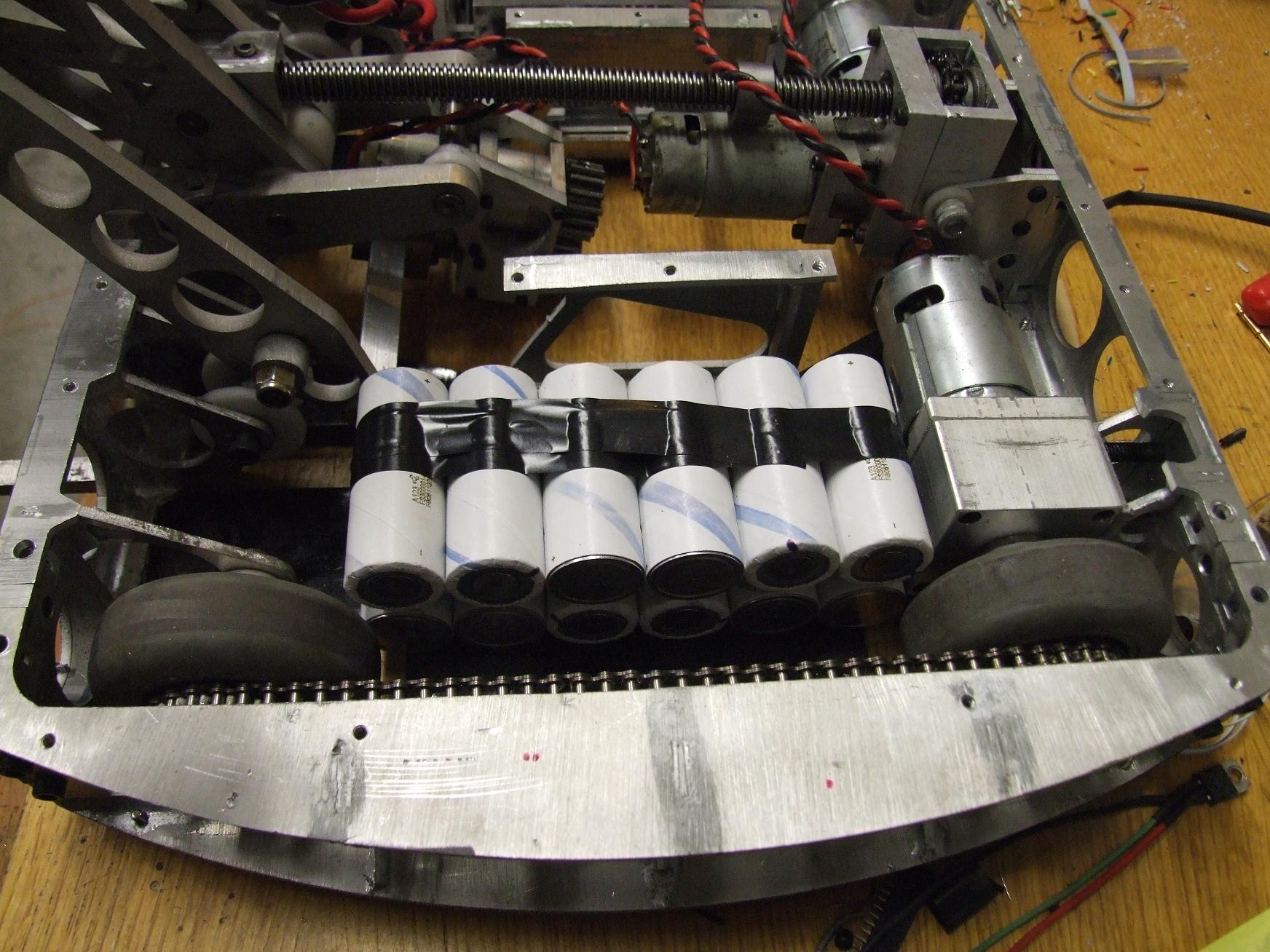
  • The 3S 1.3Ah lithium polymer battery is toast. D’oh.
  • Why the hell did I use 12 gauge wire on a beetleweight?

I’ve ordered replacement magnets and two replacement lithium packs from Hobbyking. Hopefully, with the magic of express shipping, they will arrive next week. NK fundamentally needs maybe two or three hours of work to be back to competition-spec.

How long will it actually last? I have no clue. It’s built to barely 2008 spec, and the brushless masculinity contest has grown in magnitude sine then by far. But, expect NK5.1 at Robot Microbattles on Sunday.