A New Pushybot

IT’S ROBOT SEASON!

My annual robot party, Robot Battles @ Dragon*Con, is right around the corner. Again.

This is a competition I’ve been attending since 2002 and competing in since 2003 – it’s been my “end of summer festivity” for every year since then, except 2007 when I was retained by the mits for freshman orientation.

For most of my RB history prior to the MITs, I’ve had a primarily drivetrain-centric entry, Test Bot, that worked all the time and was undefeatable so long as I didn’t mess up. After that, beginning with Test Bot 4 in 2006 and really kicking off with Uberclocker version 1 in 2008, I began focusing more on cool actuators and weaponry.  That probably explains why I haven’t won anything since, or really have a robot that can put on a performance without being unreliable. Cool weapons and whirly things are funny until you can’t get it to move straight across the arena to beat the other guy senseless with it.

I’m kind of sick of that. Lack of any real motivation to fix the drivetrain issue with Überclocker Remix thoroughly has led to its losses in 2009, 2010, and 2011. That’s 3 straight years of fail, and I can even name the reasons why. In 2009, the robot lost drive functionality early on because I dared to think that using $2.50 drive motors was a good idea (and brought no spares, also a good idea). I upgraded the gearbox and motor rig to a custom DeWalt solution for 2010, but it slipped a poorly-made output shaft and I didn’t care enough to try and ninja-fix it during the actual event. And finally, last year, with the drive motors finally reliable, the robot ditched chains left and right. Literally. Both of them. Poor tensioning results in the chains catching on… something – I couldn’t tell what was actually going on, but it cost me the tournament. Again, what just totally sucks about it is that it was no fault of the design itself, but just my inattentiveness or ambivalence.

Sigh

So I’m starting a new 30lb build which will be 100% drivetrain. The goal of this build, really, is to just come up with something that’s fun to drive and run into things with again. Piloting the (comparatively well-handling) Cold Arbor test rig around a few weeks ago reminded me of how important it is to keep your robot short, dense, and 4WD with the center of gravity smack in the middle. Soft wheels helps too, as does an immense amount of horsepower in the motors. This 30lber will act as a baseline to compare all my future designs with. The drive will be modular, with one motor per wheel, quickly replaceable and with easy to find spares (something Clocker has never been very good at). The frame will be pretty damn near indestructable. If I can’t beat the all-drivetrain pushy-brick with a new design, then anything else is pretty much hopeless. It will function as the null hypothesis test of robots – to be a proven design, it has to reject (/defeat) the null hypothesis.

Incidentally, that’s exactly what I’m calling it. Introducing Null Hypothesis:

Well gee, it looks like I’m almost done designing it already. Usually my CAD posts start off with a rectangular extrusion or something equally simple, but I’ve been slowly digesting this design for a little while.

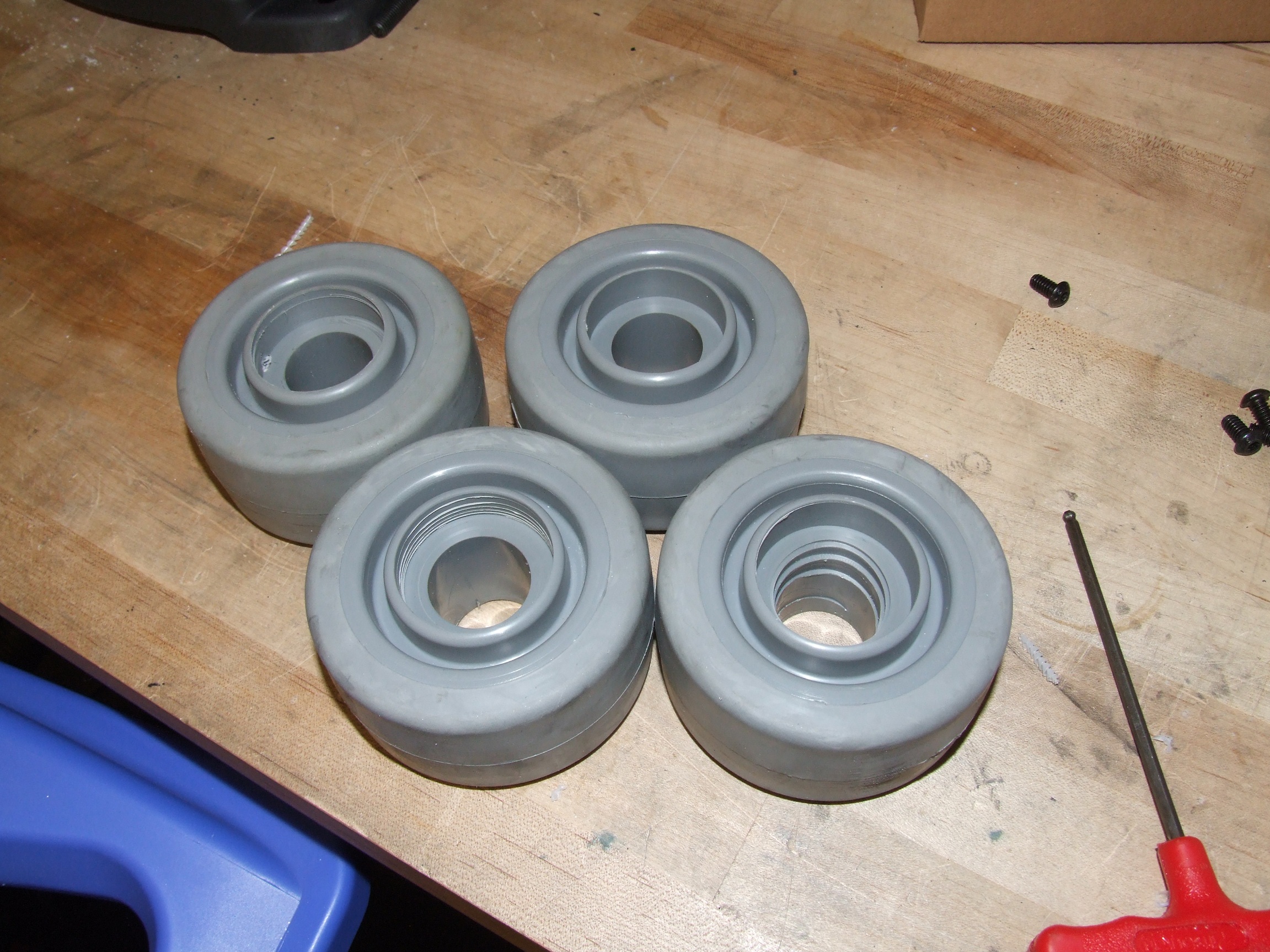
Short rundown of the design: Four 18v Harbor Freight 900rpm type drills (now on sale again as item 68239) direct-driving four 40A durometer “McMasterbots” wheels. 1″ thick UHMW bar frame, and polycarb top and bottom. True 0.75″ ground clearance each side. Classic indestructable pushbot! The outside of the bot measures 18″ x 18″, which is a reasoanble 30lber size.

The design above is the “first pass” appraisal of the concept. It has a solid UHMW front wedge that was intended to be carved from a 3 x 4″ block. That turned out to be $150 of UHMW, which seems to have gotten way pricier since my last UHMW brick in 2006, because UHMW is just condensed natural gas or something.

Note how it gets a little weird and irregular out back – I wanted this bot to have no rear traction gaps. A classic “box” frame leave you a finite, usually less than 45 degree, tip angle before the frame lifts the wheels off the ground (for Test Bot 4.5 this was only about 25 degrees because it’s so damned low). One solution was to cut up a pipe and round off the end of the frame, but this left me little space to mount the motors. Hence, I settled for 45 degree ‘facets’ that can get pushed further back to let me add mounting features for the drill gearboxes.

The ground clearance is called “true” 0.75″ because the top and bottom covers are inset into the frame. This leaves me with a 2.5″ frame that has 2.25″ of internal space given the choice of 1/8″ polycarbonate top and bottom, which actually turns out to be not that roomy.

Here’s a “second pass” of the design. When I do a “first pass”, it’s generally just to puke ideas and generate shapes. Some times I find that the shapes end up being nonsensical or impossible.

There wasn’t such an impasse with this design, but I decided to get rid of the solid UHMW brick front. As funny as it might be, I really can’t justify spending $150 on UHMW just to use maybe $70 of it. The wedge ‘sections’ are made of the same barstock now as the frame. A 1/8″ 4130 steel plate forms the business end – I got a plate of the alloy for reasonably cheap, but there might not be an oven big enough for this thing with immediate reach to fully heat treat and take advantage of its strength.

The battery and its retaining mechanism is now shown too. It’s actually really hard to make an all-UHMW 30lb bot – UHMW is just not dense enough, really, so the weight needs to be made up. In this case, it’s with theoretically enough  batteries to run 4 or 5 matches back-to-back. The intended voltage of the system is going to be 25.6 nominal, 8S A123 cells, with 4 effective cells in parallel, physically arranged as two separate 8S2P packs. This should yield a decent top speed of 15mph: not too quick, but also not sluggish. Middle of the road pushybot.

The battery packs will be made with shock mounting padding, then captured inside a 3/8″ or 1/4″ polycarbonate ‘cage’ inside (hard to see, with polycarb being modeled as transparent). The cage is part of the top and bottom plates.

Electronics-wise, I’m trying to decide between the Botbitz controllers that I got to test for Arbor, or my full-custom board (yes, again):

The hell is that thing? I christened it RAGEBRIDGE because, somehow, I have never managed to produce a reliable small H-bridge controller. Landbearshark’s custom controllers were a miserable failure for several now-obvious reasons. I’m also really in need of a synchronous-rectified current-control-capable H-bridge for an outside consulting project – which is really what this board was developed for.

So I took another stab at it. I took every precaution to not loop my grounds and cross my logic with power, so I hope this can become a reliable hardware base.

That is, if i ever receive it. It’s been nearly a month, MyroPCB. The excuse I got was that my order was ‘damaged in fabrication’ and had to be redone. Well hhmm, I hope it wasn’t all those vias….

The reason I’m still holding out hope for these things is because the BB controllers can’t do “true 24v” systems – the Hobbyking ESCs they’re based off of are rated to only 6S lithium polymer cells, or around 26v peak. There are 35v parts all over the place, including the main power capacitors, and the FETs are 30v parts. In other words, a freshly charged 8S A123 battery at 28.8v is most likely too much for them. And I’m not going to back down from that – NH will be too slow if I only run 6S.

Worse come to worst, I have all of those Victor 883s (classic ones, mind you… The FET layout above is clearly borrowed from the Victor883107-7.).

Here’s the front end of the bot. I’m most likely going to just stencil-paint (or laser-etch?) the H_0 onto the front, instead of making it a cut-through, because that weakens the steel too much. Else, I might weld a backup plate behind it.

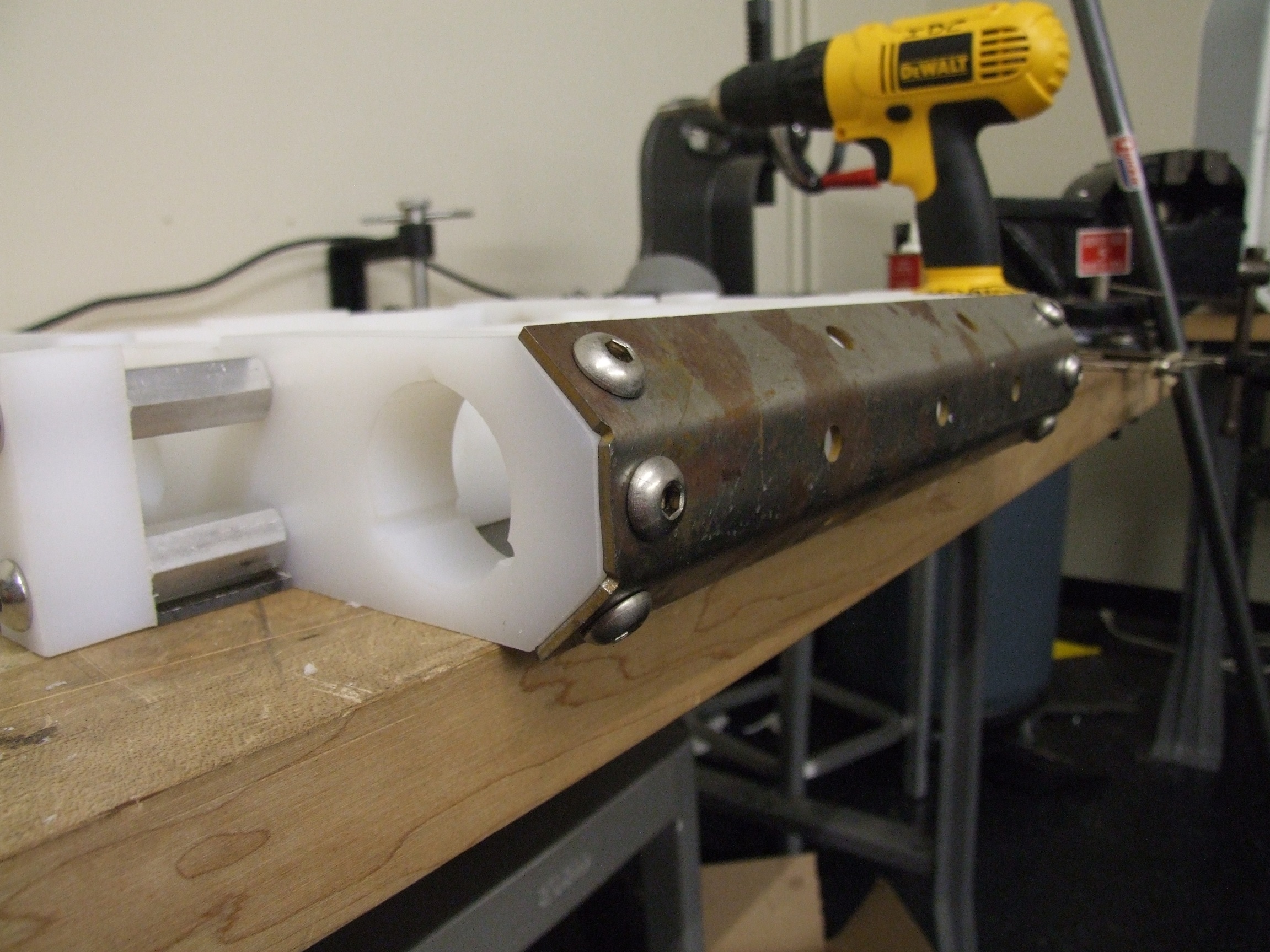
The top and bottom (and wedge) hardware on this bot is all 1/4″-20 countersunk cap screws, with the side/frame screws being 3/8″-16. Big, meaty threads. I considered using giant lag bolts for maximum grip strength, but they were not available in anything other than “giant oversize decking and timber-clamping Hex head”.

Random little electrical details will be added soon, when I can decide on the choice of electronics.

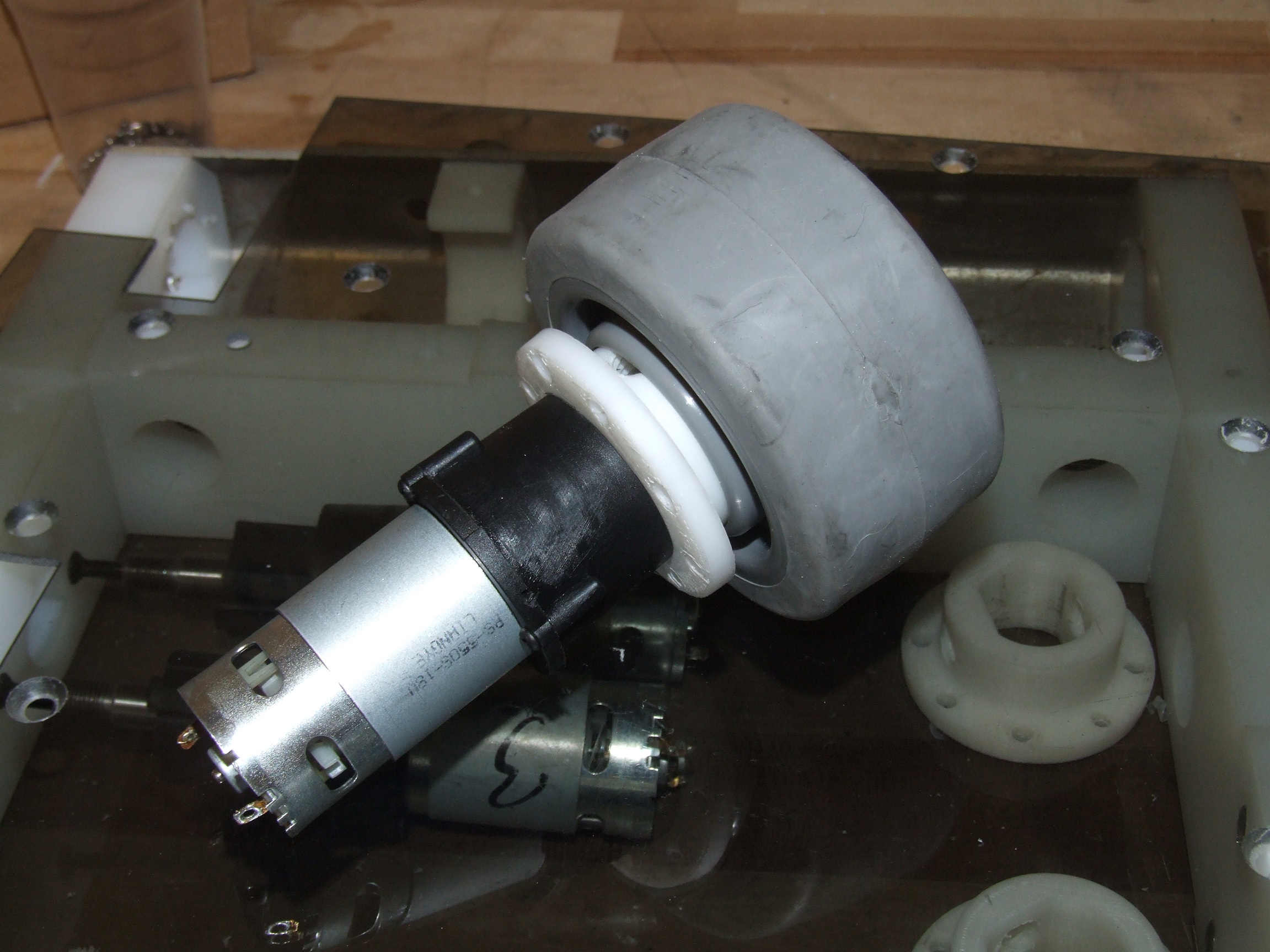
If you’re wondering where the hell the drill motors are disappearing into…

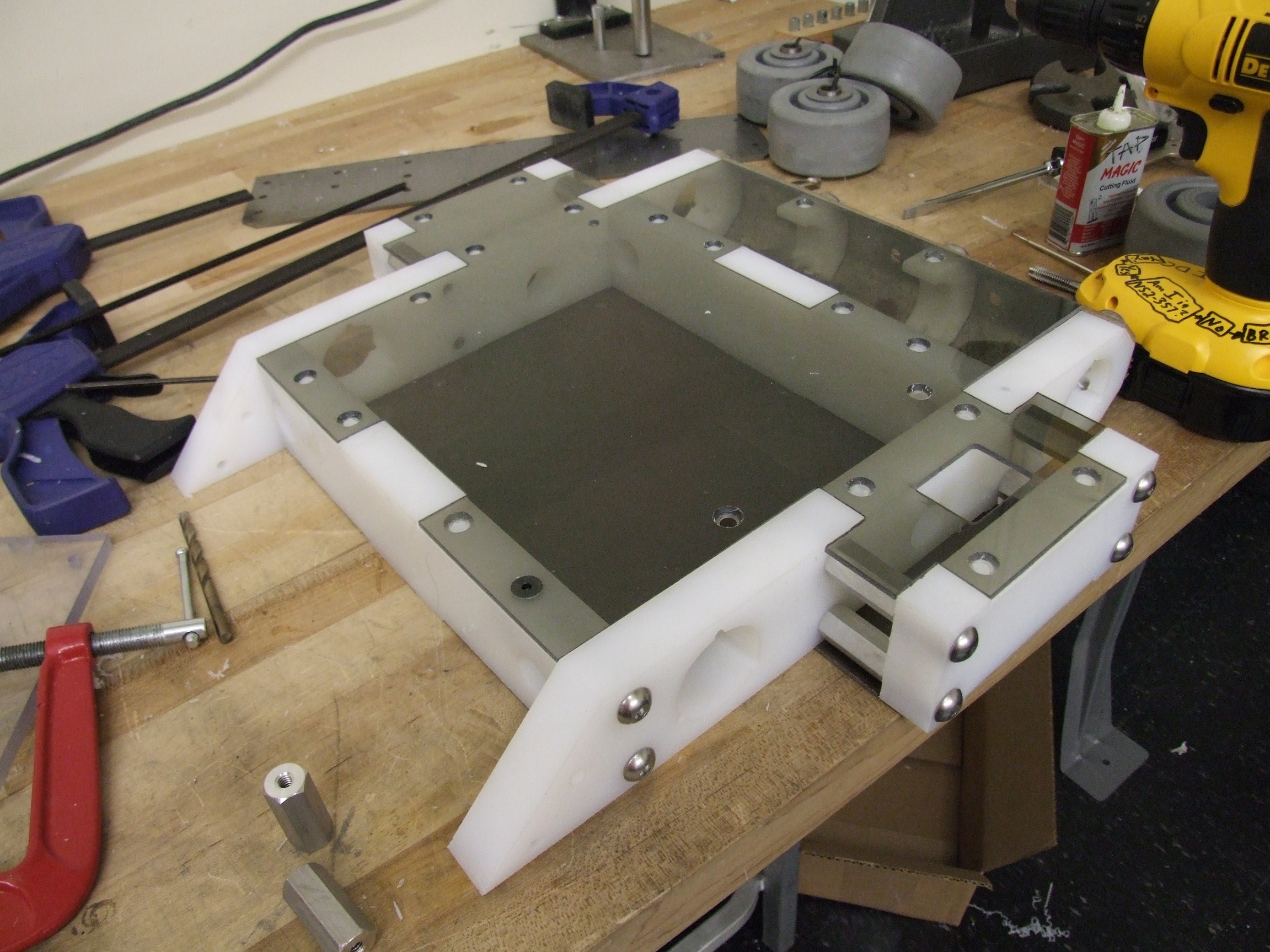
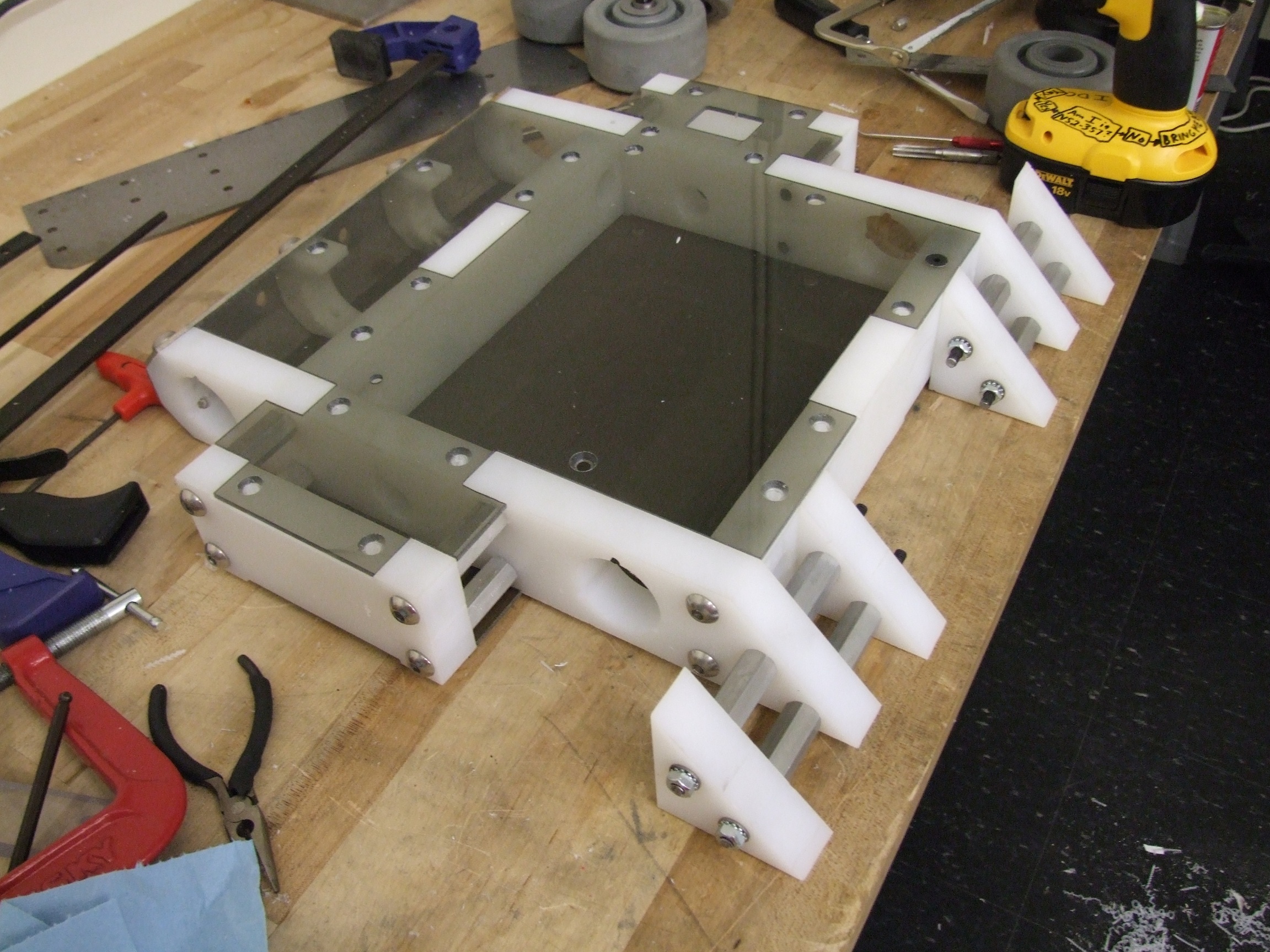
Hey, first real picture of the build!

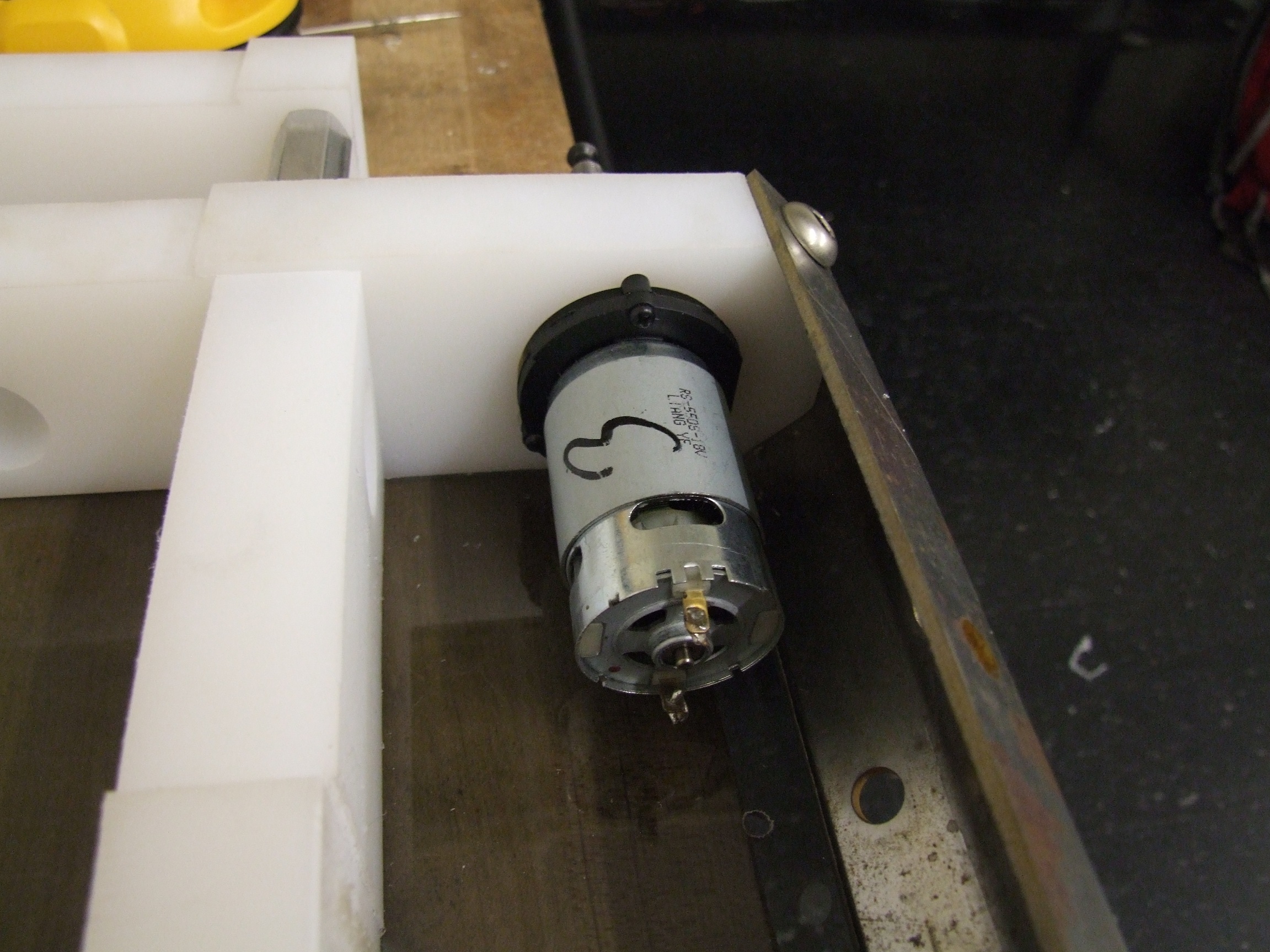
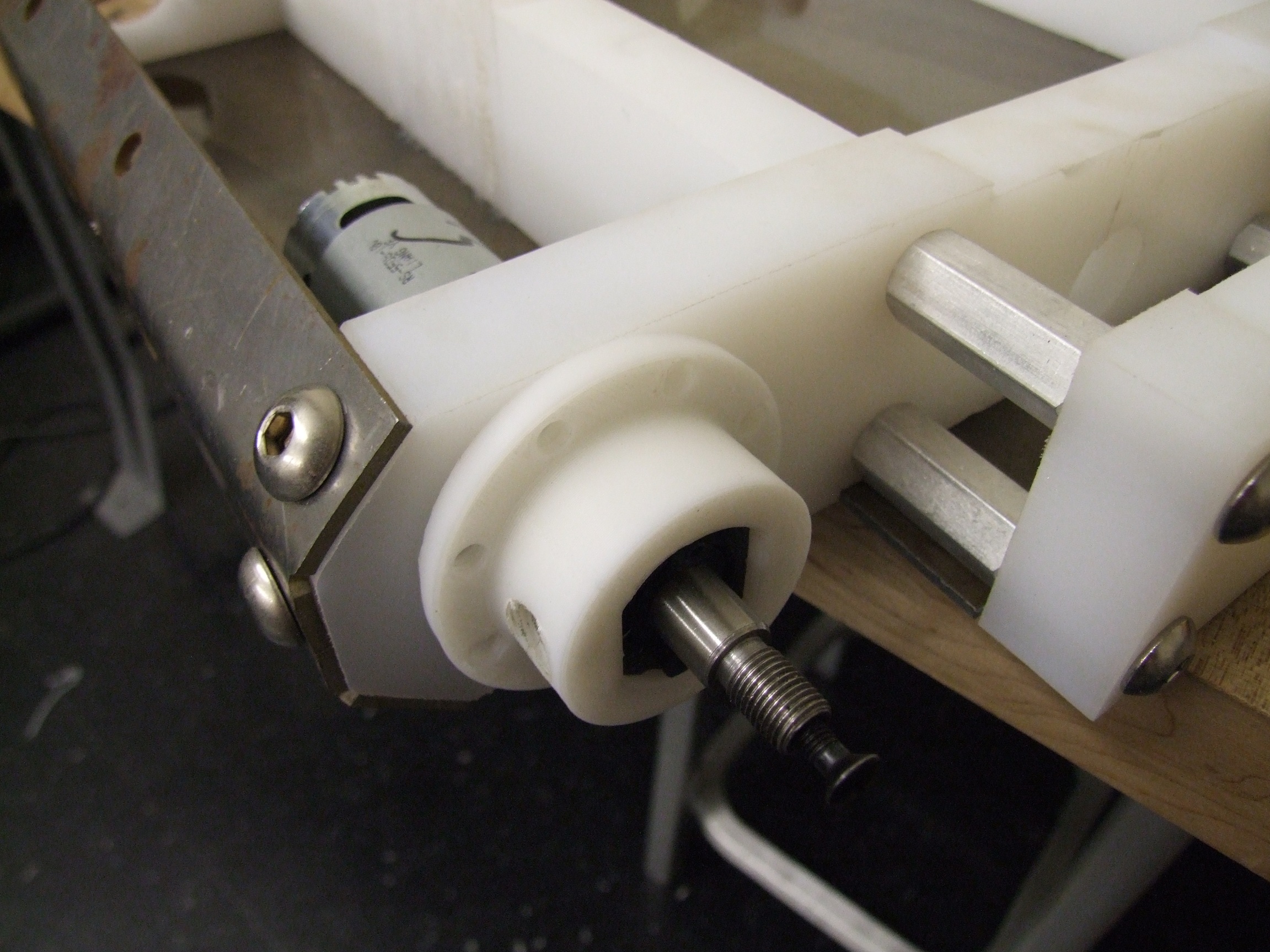
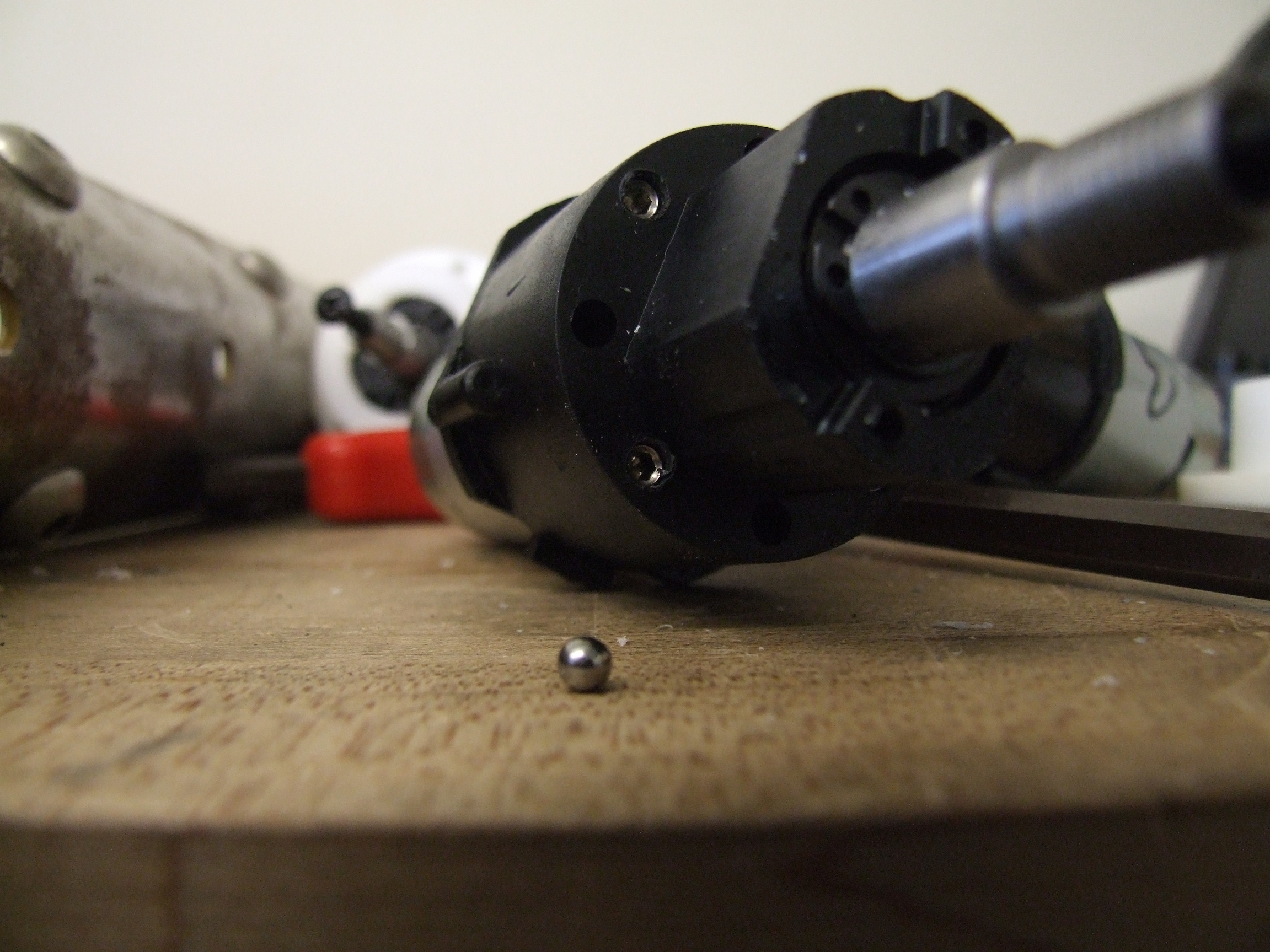
Here’s what’s going on. The McMasterbots wheel will use the nose portion of the black flanged piece as a secondary ‘bearing’. This is a scheme to avoid hanging the entire wheel solely off the 3/8″ shady drill steel axle (as is common in drillboxes). The D-shaped nose of the drill gearbox is additionally supported by the mounting flange, giving it more plastic meat. The motor is prevented from torquing and moving axially using fine-threaded set screws (the cross holes in the picture). The flange itself is screwed into the UHMW side rail.

The black plastic piece is made of ABS, rapid-prototyped on the Lab Replicator. The final version will also be made of ABS, and incidentally also to be rapid-prototyped on the Lab Replicator. On a side note, most of my complaints in that post seem to have been wrapped up in the latest firmware for the Replicator – they were probably common enough that an official fix was distributed.

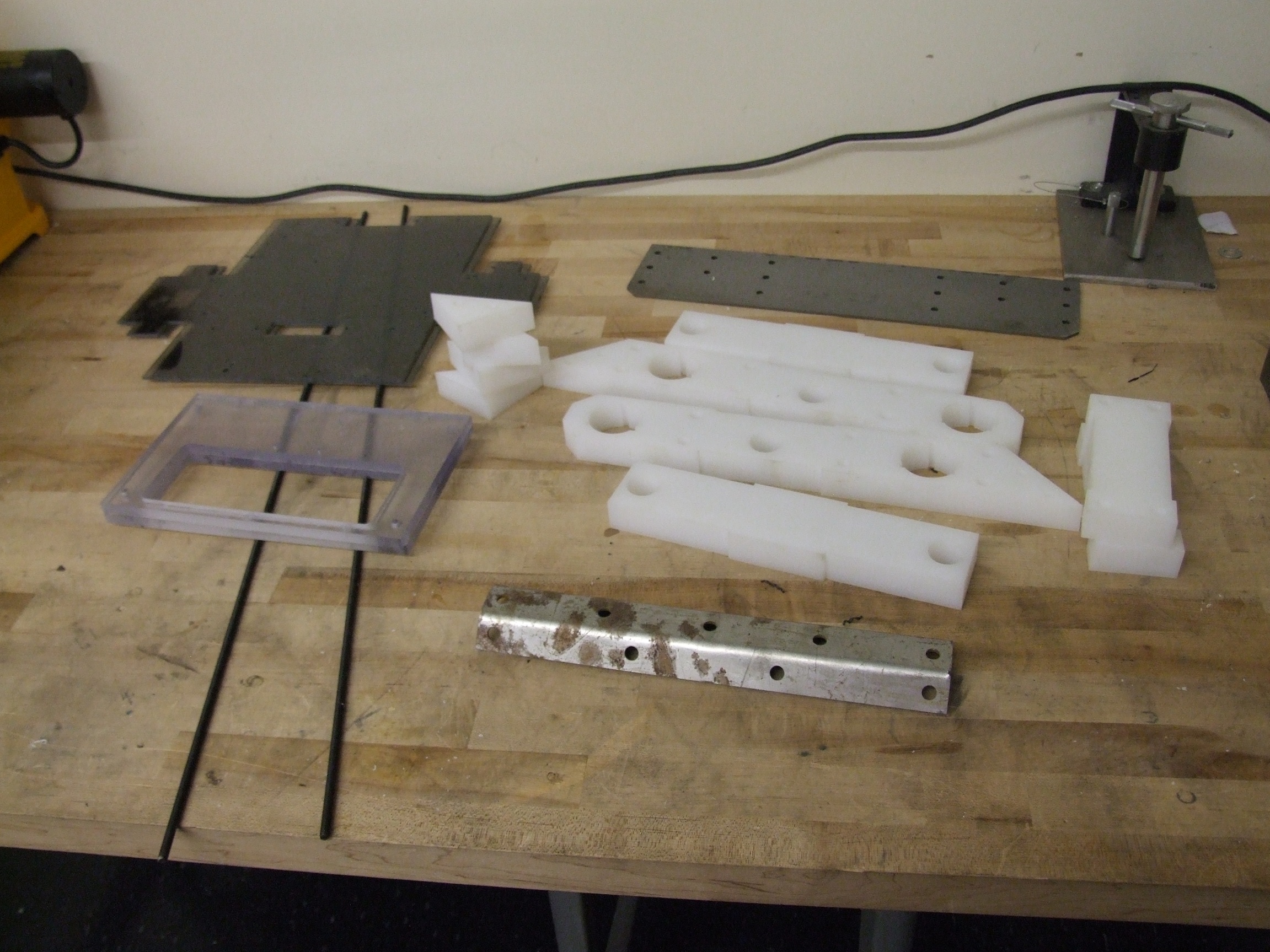
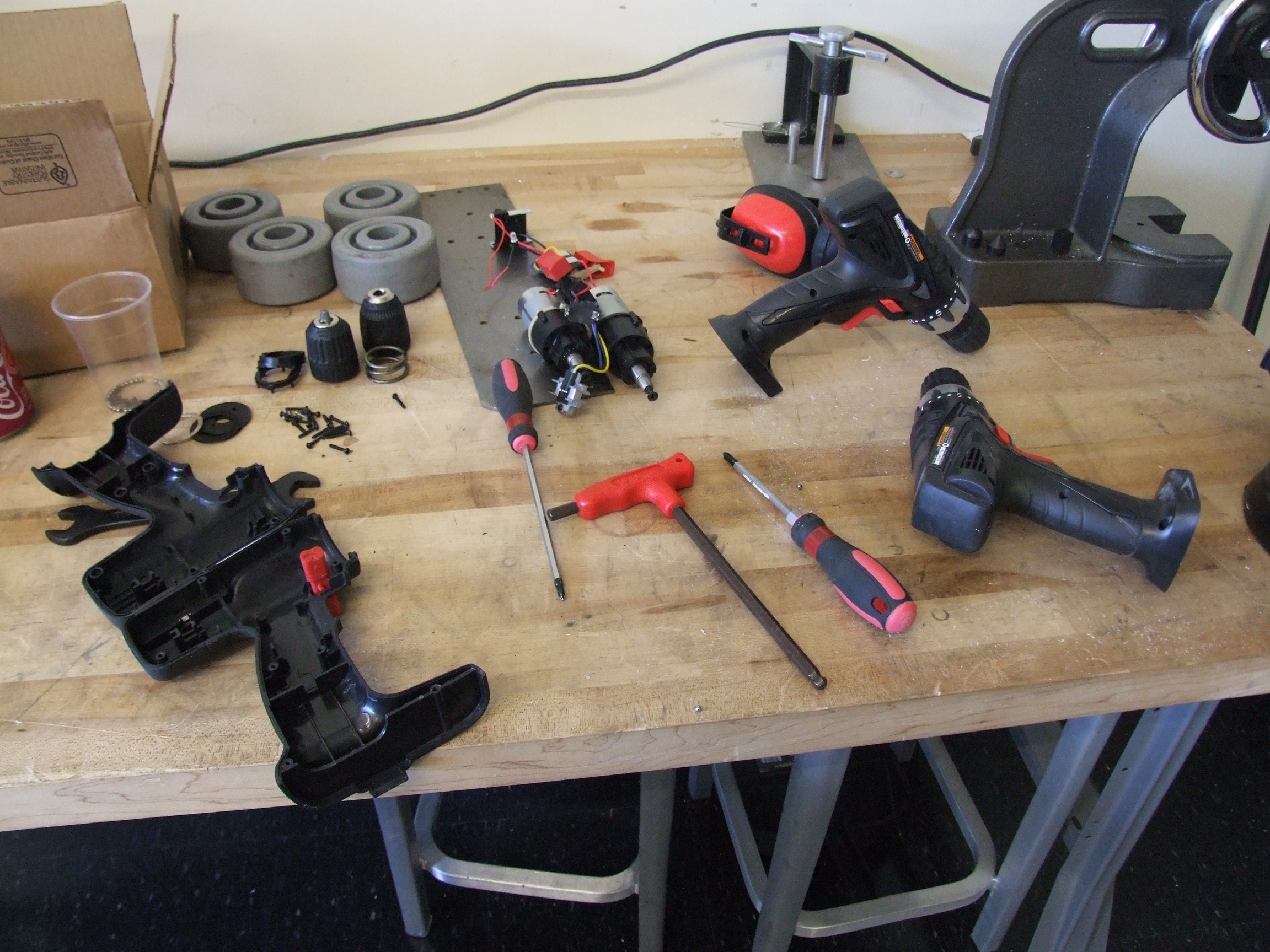
I’ve ordered pretty much everything I’m going to need to make the mechanical bits of this bot in the coming two weeks or so. I have eight drills now, and the buffer pile on my desk is becoming insufferable.

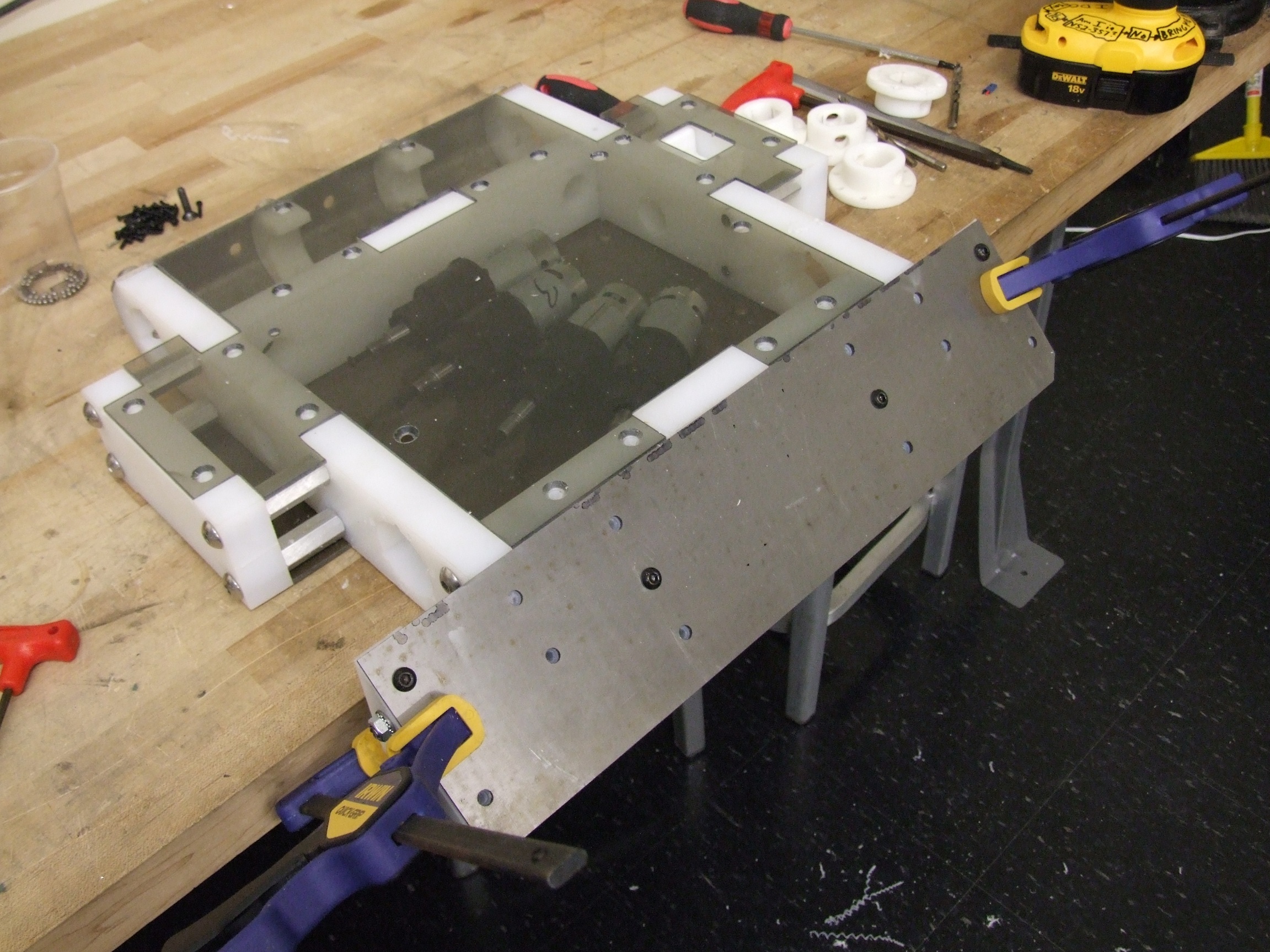
I have to make a decision about how to build the frame. While I was initially going to buy and mill slots in UHMW barstock, I snagged a large plate (48 x 8″) of UHMW on eBay for very cheap. It has all of the square footage needed to build the frame, but separating it into chunks will be a bitch.

While my normal tactic when faced with a giant plate and needing bars and shapes would be to Just Waterjet It, UHMW is well known to be so soft and abrasive resistant that it cuts poorly.

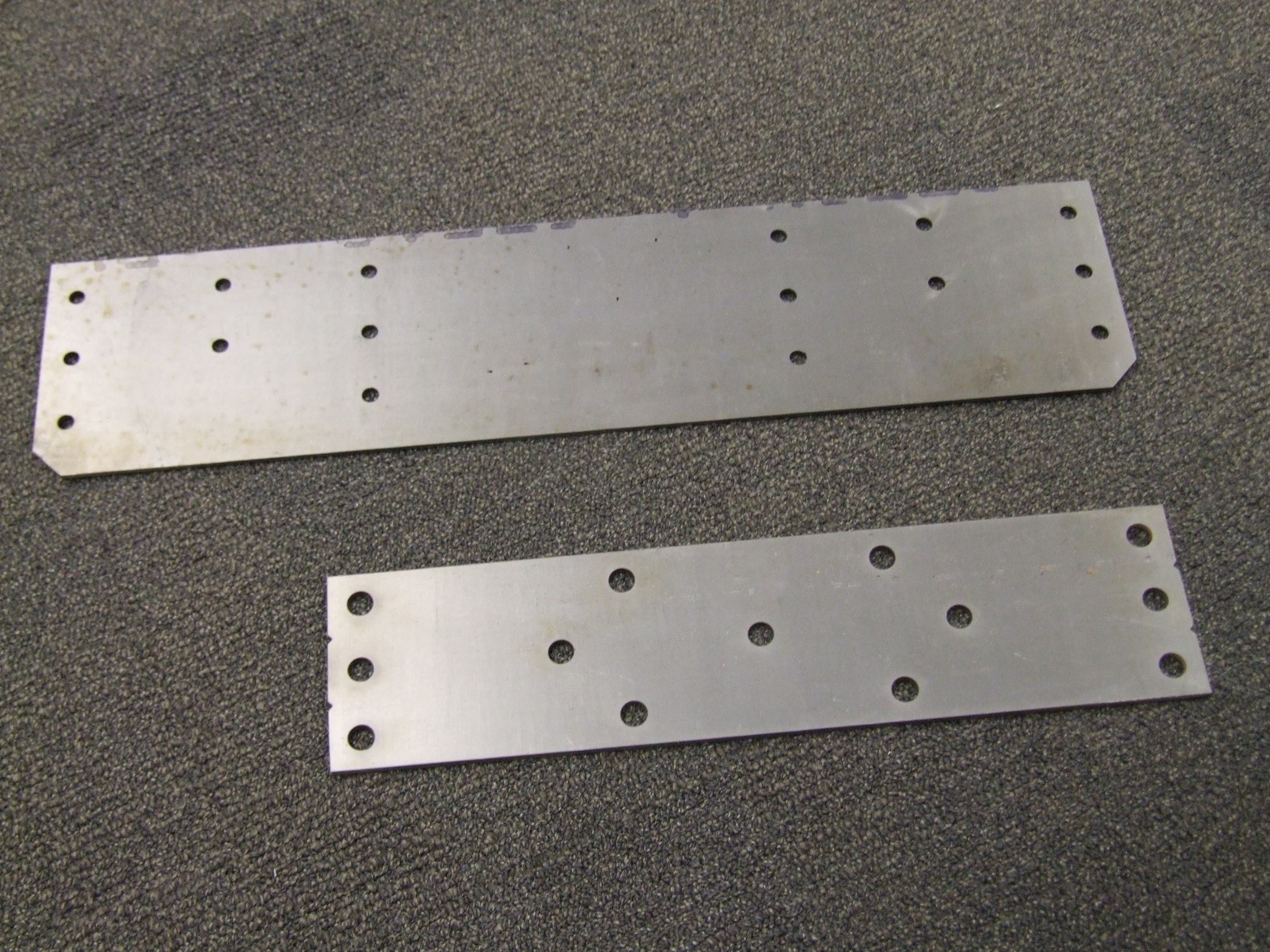
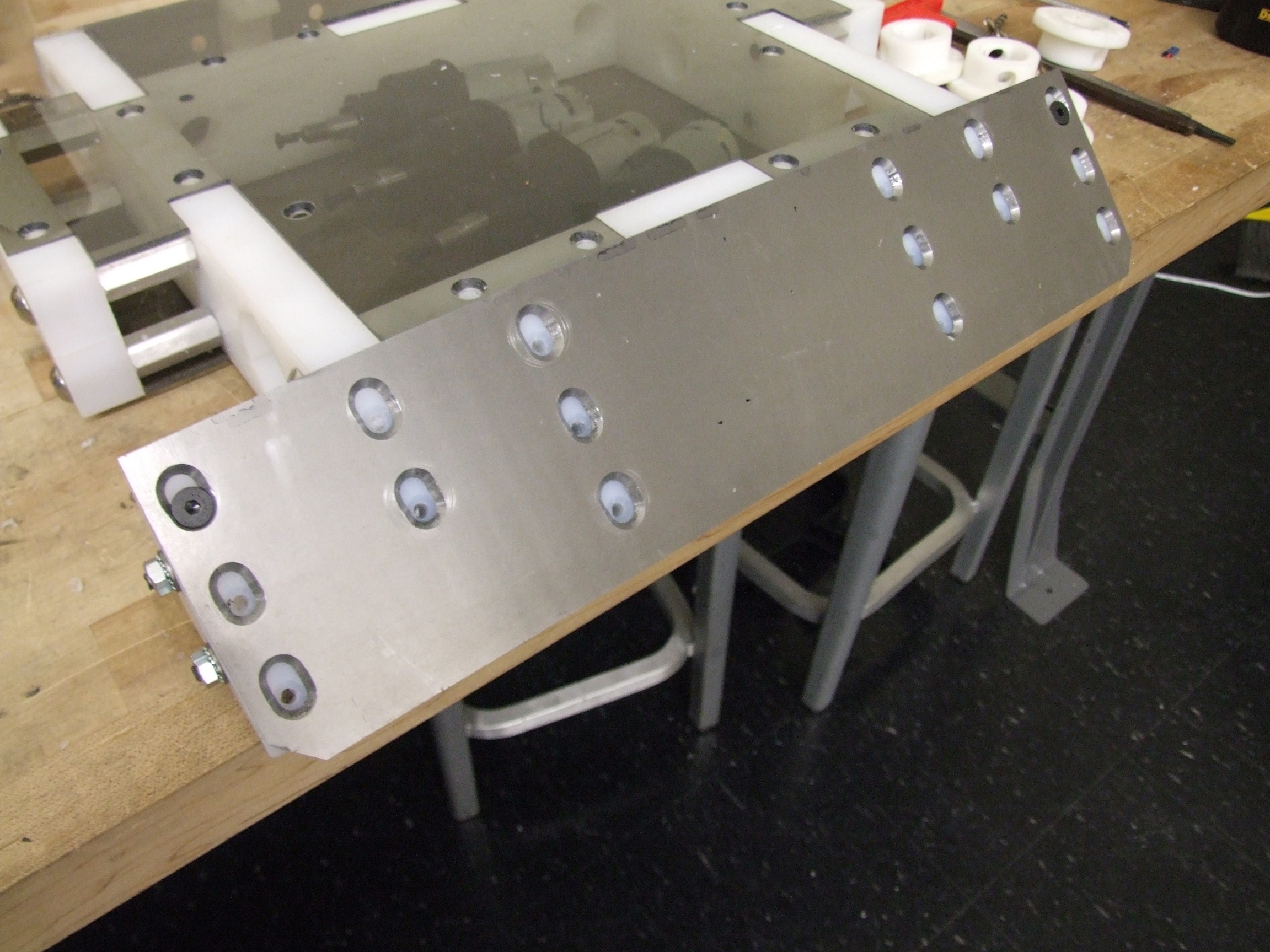
I laid out some test parts (these are the side bumper things) using different qualities to see if any were remotely tolerable. Anything short of high quality (or in Omax terms, “Quality 5”) just doesn’t even make it through all the way, and I can’t get the part out of the material! Even the above piece, which was on Q5, needs all the holes drilled out. The outline is reasonably acceptable, though, and I may make the parts which don’t need to be critically square using the cheap plate. This include those side bumpers as well as the little wedge triangles.

I bought a 4 foot stick of UHMW for the parts that can’t be waterjet-cut, but I might have to get friendly with this plate and a slitting saw in the near future.

This is not it. I have several other robot updates on deck as August rolls in, including:

  1. My kinda-open-secret project of creating a new arena hazard for the new Atlanta Bot Arena
  2. The last round of updates to Überclocker before it will be retired after this D*C event
  3. Maybe a new beetleweight design that I’m tossing around.


All Good (And Poorly-Maintained) Things Must Come To An End: The Great Project Purge of 2012

i swear to god i will fix this later

At some point, I need to stop telling myself that. It’s well known that my stuff isn’t exactly world-class in terms of reliability and Six Sigma class in quality, but even I can get sick enough of it to declare it a loss and start over. Over the past few months (and years) of neglect, quite a few of the robots and silly vehicles have become damaged and non-operational. I kept Swearing That I’ll Fix It Soon, Guys, but my shelf of stuff is long past overflowing with parts and project detritus and some of them contain good parts that I don’t want to keep buying. With my general shift of operations towards the newly opened IDC space just up the Z-axis from MITERS, tearing down some of the old derelicts and returning their parts to the Earth (/my storage bins) became more appealing – especially as I started collecting more stuff, most of it landing on my fresh new corner desk.

So it is with great sadness (and hidden catharsis) that I must announce the decomissioning of…

Cold Arbor

Cold Arbor never really worked – the frame was too flexible to accommodate the huge teeth of the saw. After Motorama 2010 and Dragon*Con’s Robot Battles ’10, CA pretty much only ventured off my shelf for the occasional demo – it illustrated, visually, what a “combat robot” was very well. Pretty much everyone’s first reaction at the word “Battlebot” is “You should put a saw on it to cut through the other robot!”, and CA is…. well, pretty much a saw. It never really stopped driving, but then the saw actuator broke so it couldn’t do the extending thing any more. Arbor, being the biggest lead weight I had on my shelf, was therefore the first to go.

But before I tore it totally down, I decided to use it still-functional and very smooth drive base as a test dummy.

Last year in the Austrailian robot fighting circle (did you know that Australia has a very active robot combat scene too?), one of the builders began to modify Hobbyking brushless controllers to act as H-bridges for DC drive motors, utilizing 2 of the 3 half-bridges available on the average BLDC controller. I’ve been advocating something like this for a while – use the cheap hardware base that is Chinese brushless motor controllers instead of custom-developing an expensive niche robot controller solution. The choices in robot controllers these days are either said niche and expensive but generally reliable controllers, or these one-tiny-FET-per-leg overfeatured doodads that I’ve literally had zero success rate with. Or you straight build your own and have them work, but I’ve also not successfully managed that yet. There’s nothing on the market right now which is just a bucket of large FETs like the old Victor 883s (which you can still buy, but they’re now a design so old it can almost drive).

That aside, I have also never bothered to schematic-trace the brushless ESC boards or learn & put up with enough raw Atmel C to reflash the microcontrollers (though I suppose I could have flashed Arduino onto them…). So, a ton of hot air rage on my end, but lots of action in the 40+page thread over on the Robowars forum, which has seen all of the cheap common ESCs reverse engineered and firmware implemented for – up to and including its own confusing beepy configuration menu.

They’ve now started selling them (when I say ‘they’, I really mean like one dude), and I took the chance to get some modified “85A” units based off this Hobbyking ESC.

First, I had to remove most of Arbor’s existing electronics. Okay, so my success rate with the Sabertooth controllers isn’t zero – Arbor runs two of the closely related SyRen controllers, but $75 for 25 amps is stupid these days, and I’m also royally undersizing their loads – one is running a little Speed 400 class motor and the other is running a drill type 550 motor which sees about a 10% duty cycle on raising and lowering the saw.

Way cleaner wiring and layout with the ESCheap85 in – I could easily see a robot with a whole rack of these next to eachother. The massive spam of SMT FETs technique used to great success by cheap Chinese controllers is an acceptable compromise, in  my opinion, between one-tiny-SMT-FET per leg used by the Sabertooth and Roboclaw and other most-likely-designed-by-newly-graduated-college-students controllers, and the one-huge-nice-FET approach I usually take. It keeps the board size down, too.

After hooking this up, Arbor was taken on several somewhat strenuous (and absurd) test drives.

None of it was very scientific, nor was there really enough space to seriously stress the bot out. I’m going to have to use these in battle myself before I’m fully sold on the idea, but based on the reports of the substantial number of Australian users, they’re pretty bulletproof, and a few American users have already run 18v DeWalt drills in drivetrains using them (the same motors that Clocker uses). The 85A type has been praised as a “Victor replacement”, but its more limited voltage range (30V fets and 35v capacitors) doesn’t quite convince me it can be swapped directly into a native 24v (up to 28v fully charged and more during dynamic braking) system. I fully agree with the concept, though, and for about $1 per amp I don’t have any complaints past my own reservations.

That doesn’t mean I’m no longer going to attempt my own controllers – I have yet to successfully execute a small current-controlled vehicle H-bridge, of which robot controller is a simpler subset. But that’s for another post.

At the end of it all, here’s Arbor mid-scrapping:

Scrapping is such a negative word. It took me a while to crack open that weapon drive gearbox, since I sealed it up so well at the start – and some of the bolts were bent.

Here’s everything I ended up keeping from Arbor. All of the motors, pretty much all of the drive mechanics (especially those delicious custom gearboxes, which were one of my first good ones), and of course the saw and worm drive in case I rebuild it all. The VictorHVs and Sabertooth controllers were also kept and filed in my robot controllers bin.

prospect for rebuilding: slim

Arbor was a very complicated robot with lots of moving parts – it’s something which is more difficult to get right, and it’s usually more disappointing (to watch as well as to operate) when it doesn’t work. Arbor’s build was rather rushed and many details weren’t completely thought out. I’m more likely to build a 30lb bot that is either more plainly functional or spend alot more time to build a complex but well-designed and tested robot before trying to compete with it.

Going down the line, next I pulled out…

nuclear kitten 5

NK5 was heavily damaged last Robot Battles, and ever since then has been sitting on the shelf. However, the disc motor still works great – and I can make spare discs, so that’s definitely being reused on something. The controllers and motors were also potential salvage items.

NK5 was the last robot I built before I converted fully over to “T-nut” style construction, visible in pretty much all my stuff from 2009 onwards. The design actually dates from late 2008 – my first major t-nutted endeavor was the ill-fated 2.007 robot. The frame has these wonderful corner bars that I machined for this application, but it seems like now you can buy everywhere. I really liked these, so I went ahead and saved them. Tapping into real metal is way better than t-nuts at any rate.

Here’s NK’s remnants pile. The frame materials were just not worth keeping, but I kept the motors – the gearboxes are not stripped, but one of the pinions fell off (but is intact). They might become donor parts for future gearboxes. I am a fan of these little 25mm metal gearboxen: while they are not planetary, they’re big and chunky inside to make up for it, and fairly cheap at $10-15 each.

prospect for rebuilding: hell yeah

I can’t guarantee when, but D*C 2012 is likely because I pretty much have everything-minus-frame. The disc is up for some revision, though. Big tall vertical disc spinners are no longer in vogue, being replaced by small, low bricky drum things with built-in motors (of which there are now like 50).

Next up is my pride and joy,

test bot 4.5 MCE

Really? The bot that made it to real-deal-Battlebots-IQ, then Motorama 2008 and back? The first thing I ever worked on at MITERS? Yep, since its default parking spot since Moto 2008 has been in Clocker’s lifter when it’s not doing other things.

TB certainly has the most grime of any of the bots, and the lifter was pretty much utterly trashed – it took a direct from the vertical disc bot Igoo at Motorama 2008 (that video is slightly painful to watch).

This is one of my first drill motor hacks. I did a few in 2006 for the original TB version 4, but they were either terrible or dismantled very quickly. This thing predates my entire website, pretty much. The extension shaft with the pinion was added when I redesigned the lifter for Moto 2008. It had an additional outboard support, but since it was made of UHMW, the whole gearbox still flexed too much to keep the gears in mesh, and so the pinion stripped very quickly in battle.

After I took the damaged arm parts off, I realized that TB’s drive base was actually in very good mechanical shape. I still love those gearboxes, too: they are super special 12:1 drill box hacks that I made with mating the salvaged 18 tooth planet gear and 9 tooth pinion gear of the first stage of a drill motor with an intact output stage. Coupled with the extremely overvolted 9.6v drill motors, this made the bot have a rather zippy top speed of 14mph. The first version of this gearbox predates the website (again) – this version at least had the luck of being milled, so things actually lined up!

I briefly entertained throwing the BotBitz ESCs in the frame just to drive it around again, but decided against it for the time being. It’s sure been a long time since I’ve had a 4WD drill-powered box.

So I closed it right back up again. Only the damaged arm and wedge parts were scrapped – otherwise, I think I can put something interesting in this bot again, or at least give it a better sendoff at a serious combat event later on, as the most honorable fate for a combat bot is still, in my opinion, being thoroughly vaporized into a cloud of small particles.

prospect for rebuilding: not for Robot Battles

TB4’s design was optimized for “arena” combat which has more guaranteed smooth floors and a more pressing need for huge, thick angled armor. The RB stage is purposefully left fallow to discourage pure wedges – a passive aggressive attempt at encouraging more robot creativity, which I contend has been successful in the past few years even though it kind of locks me out from competing in 12lbers again there with this design. Maybe Motorama 2013….

Finally, a project that I hate to see get tossed so early, but…

razer revolution

It’s lived a decadent life of being a demo attention whore as well as occasionally coming in handy when Melonscooter was on blocks, and has seen 4 different motor controllers (Double DEC’er, Melontroller, Tinytroller, and Jasontroller!), but recently RazEr Rev has become kind of a wreck.

I donated the front end to another MITERS scooter effort after the new battery got 2 dead cells after only a few weeks – definitely a case of bad initial conditions. Since then, it’s been sort of chilling in a corner, slowly being eroded away by the tides of cruft and dead power supplies that ebbs and floes around the shop.

The Jasontroller works great, the battery can be surgically corrected (I’m literally going to scalpel/X-acto knife the dead cells out and make it into a 10S pack), and the Dual Non-Interleaved Razermotor is a little rattly in the bearings but otherwise functional.

So that’s pretty much all I kept. Oh, and the extra heavy duty generation 2 Razor handlebar, after they moved away from welded-to-frame folding joint but before cost cutting made the joint like 24 gauge steel. This front hinge is massive – the steel is something like 0.13″ thick.

The reason I decided to scrap RREV now is because I’ve become dissatisfied with the frame design. It uses a design which I now consider inferior to other similar scooters in the way it’s put together. Starting over with the frame will be a great way to optimize the design towards less material use (like giant plates of 1/4″ aluminum) and make it simpler to assemble in addition to making dedicated space for the battery and Jasontroller, both of which were “aftermarket” additions. It should end up lighter for the same performance, but I don’t see it getting any smaller. Sorry Jamo, but Razor Wind is a little on the small side for my tastes now.

All this talk of what I’m gonna do means the

prospect for rebuilding: immediate

I already ordered some more giant aluminum plates (…sigh) and will probably be redesigning the frame this week. I’ve already got the changes planned out – they’ll just need execution. Like NK5, it will just be a matter of moving old parts over to a new chassis – there’s otherwise not much about RREV that I’m unhappy about. It’s definitely going to get a stock fender.

other stuff

I didn’t take any pictures, but all the Chuckranoplans have been parted out and recycled too. I’m probably not going to be touching this for a while until I stop being afraid of foam so I can build meaningful scale models. 3D printer models were fun for design practice, but are too heavy to work.

Alright, now that I’ve eaten half my offspring, I can start considering rebirthing them again!