Pop Quiz 2 Update 2

The calm before the storm has begun.

After two weeks of hosing, I now have a week of reprieve before the wall of finals hits… hopefully not too hard.

So naturally I’ll take the opportunity to catch up on two weeks of building. First off is Pop Quiz, which I actually have a fair percentage of the parts for.
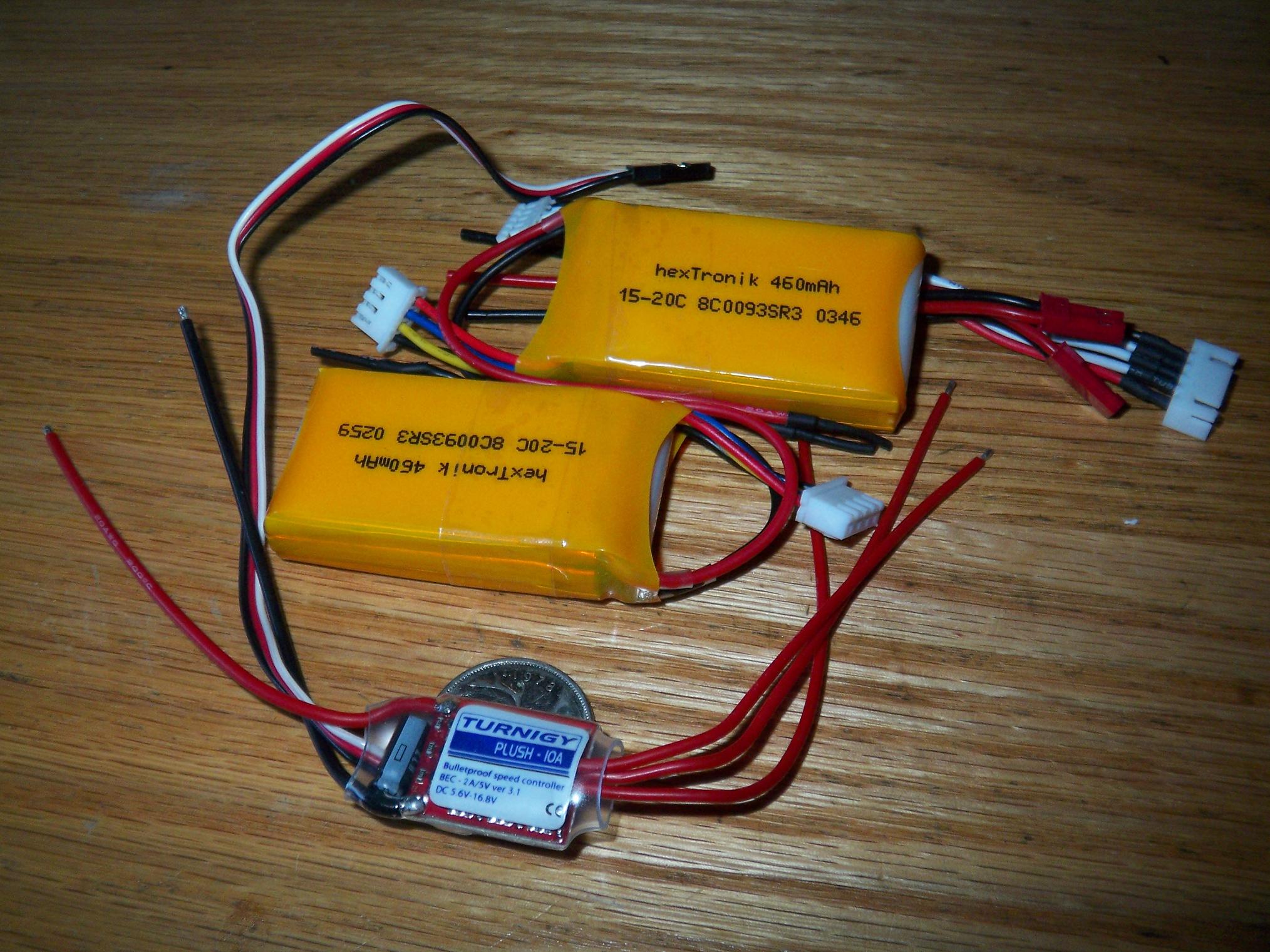
From United Hobbies are the replacement internal parts. After some idea juggling, I settled on some 460mAh packs rated for 15C discharge. This of course gets me an incredible 6 amps of maximum current, but given my intention to run everything in the bot mildly, should not get in the way.

These packs are 3S each, and I will remove one cell from each pack, then series the remaining to yield 4S x 460mAh.

The new 10A controller is unbelievably small – MUCH smaller than Pop Quiz’s current 10A controller by far. It has one SO-8 FET per leg of the motor driver bridge.

Still missing is the micro-receiver and drive ESCs. These parts are contingent on whether or not I can shove the old ones into the new design.
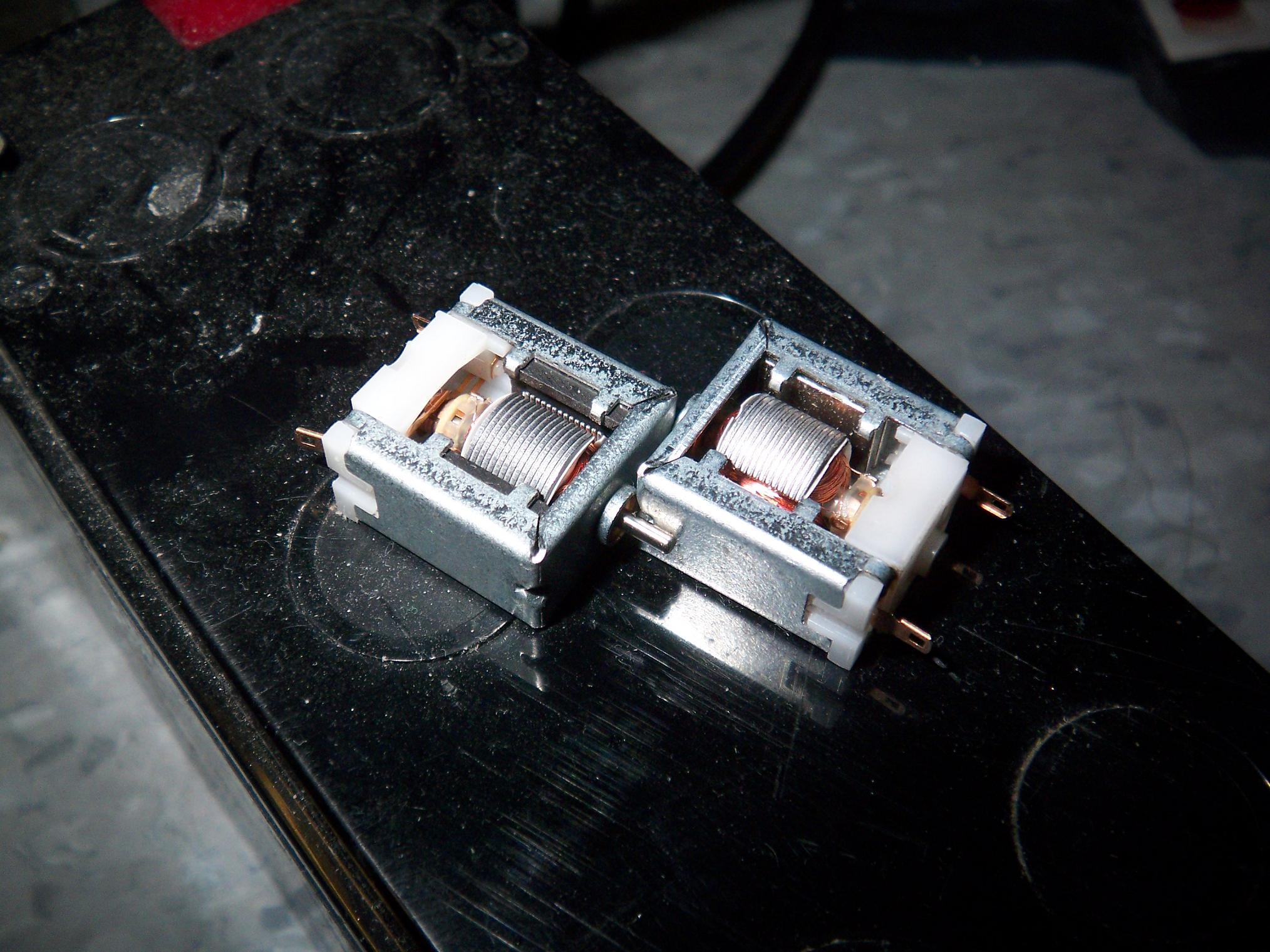
PQ2 drive motors! This is a side-by-side comparison of the stock Mabuchi slot car motor, and the neodymium-tuned one next to it (On the right). The “freewheeling noise” of the “enhanced” motor is substantially lower. According to my R/C meter, it draws an obnoxious .4 amps no-load, but oddly enough, runs smoother and with significantly less brush arc than the stocker. I wish I had some real equipment such that I can collect real data instead of jamming my finger into the rotor to see how easily it stops (Alot harder to stop the new motor, by the way!)

SDP-SI is out of stock on the exact size gear I need to fit the new drivetrain. Go figure – I’ll keep bugging them until they are restocked.

With those little details on hold, it was time to work on the new motor.
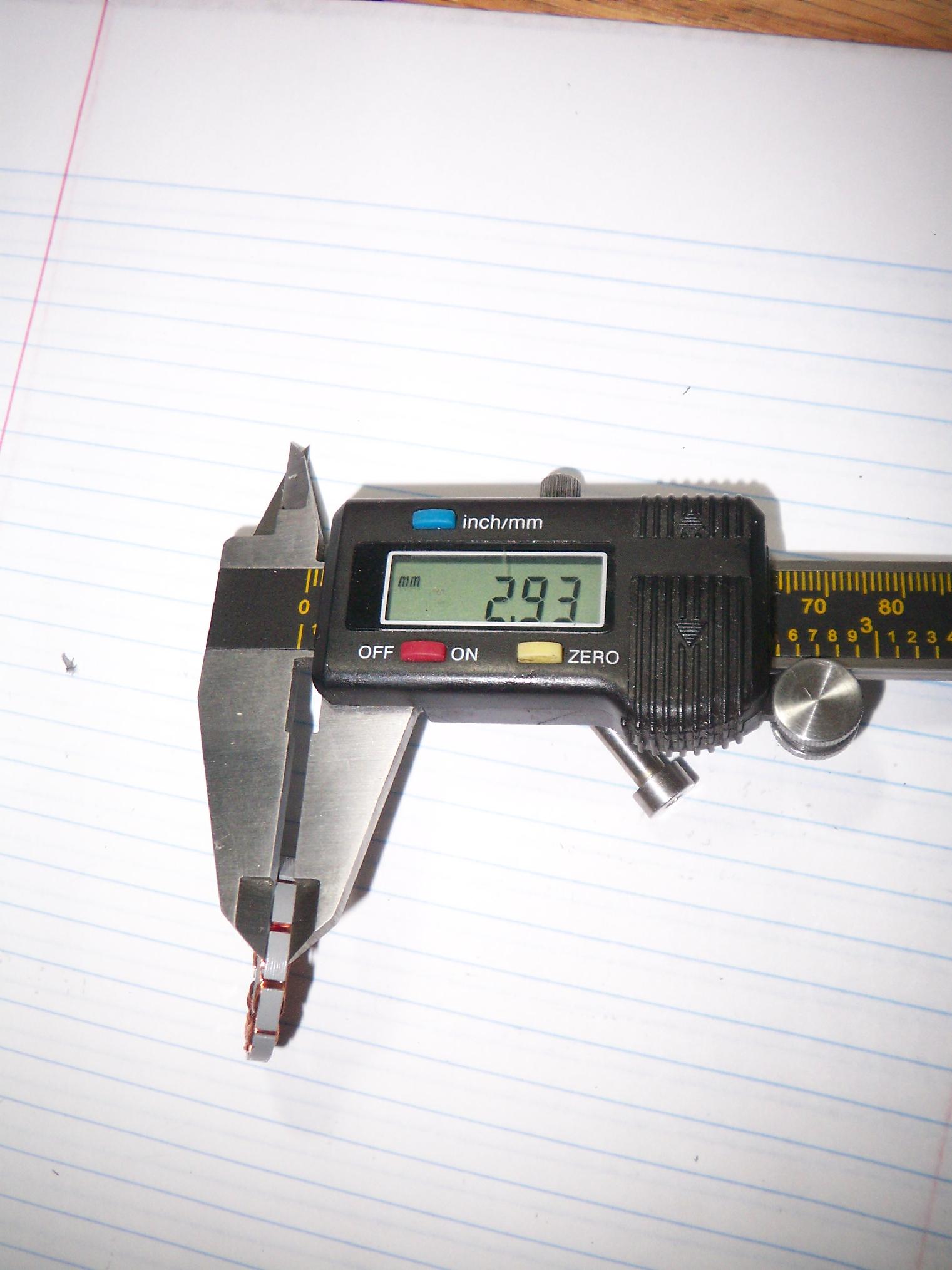
…but alas, disaster strikes even before starting.

After popping the stators out of the motors I intended for the bot, I discovered they are in fact 3mm thick, not 4mm like I had visually inspected (Note that these aren’t the “flat motors” from the last update, but rather some HDD motors I had bought in 2006)

This was quite bad, as I had sized the design for a 4mm tall stator. This isn’t to say 3mm won’t work, since small fits in place of large, but would cost me some power as well as style points.

What ensued was a night of terror levied upon a box of old hard drives sitting around MITERS. I went through one of every unique make to see if they had usable spindle motors. There were only 4 brands and models in total – the rest were duplicates.

(MITERS obtained this after some server cluster on campus dumped their old hardware)
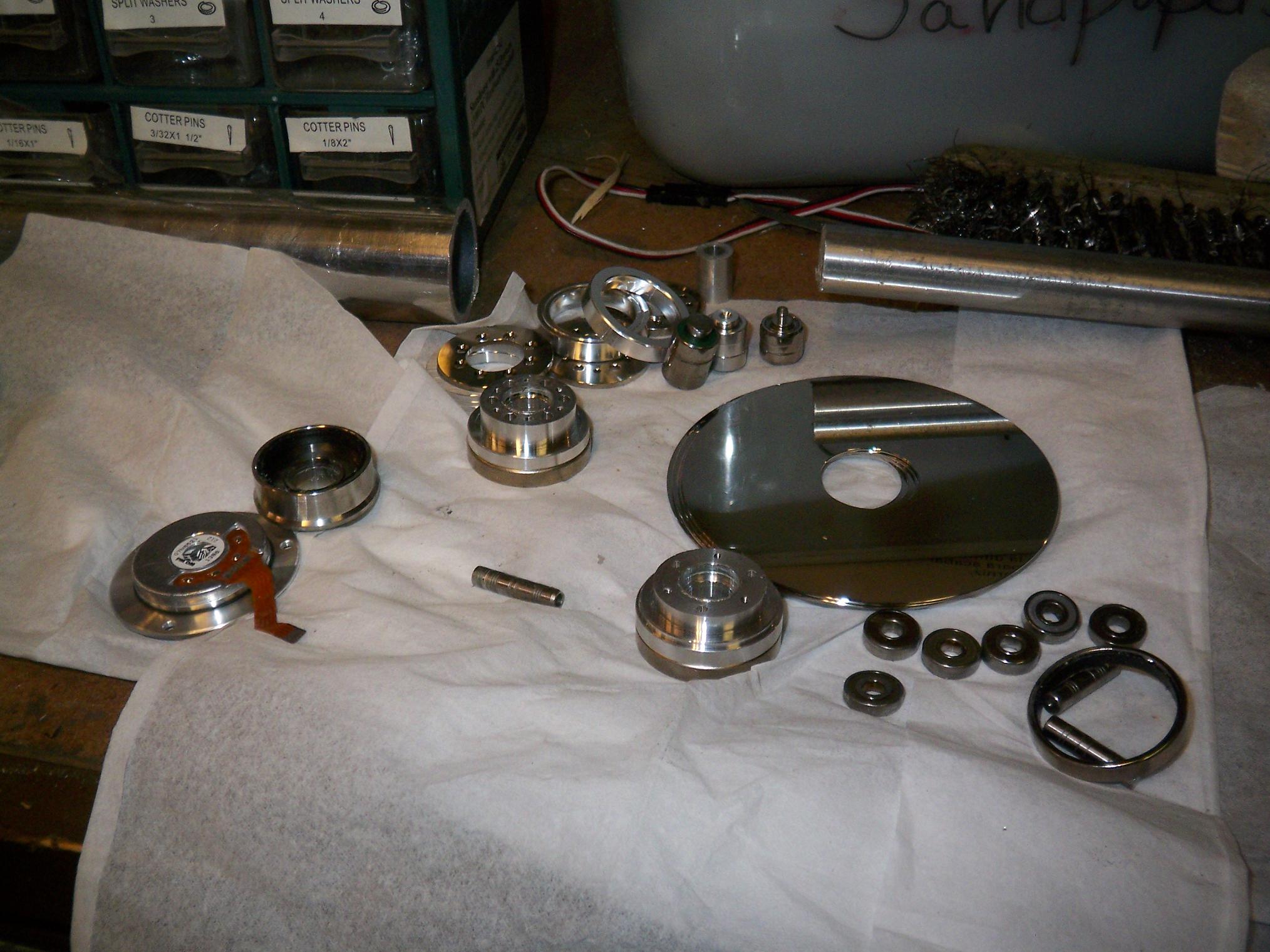
I hate new stuff. I really do. Because they ALL LOOK AND FUNCTION ALIKE on the inside. Not a single 4mm, 12 pole motor was found out of four drives. The only 4mm stator was 9-poled and 20mm in outer diameter, totally unworkable. Of course, going through more was only going to be redundant, so I called it a night and just worked on the motor frame itself.

I have some older (1990s) hard drives hiding under my bed that might prove more useful. Old things tend to have bigger motors. Or I could just harvest some plates from one stator and transfer them over.
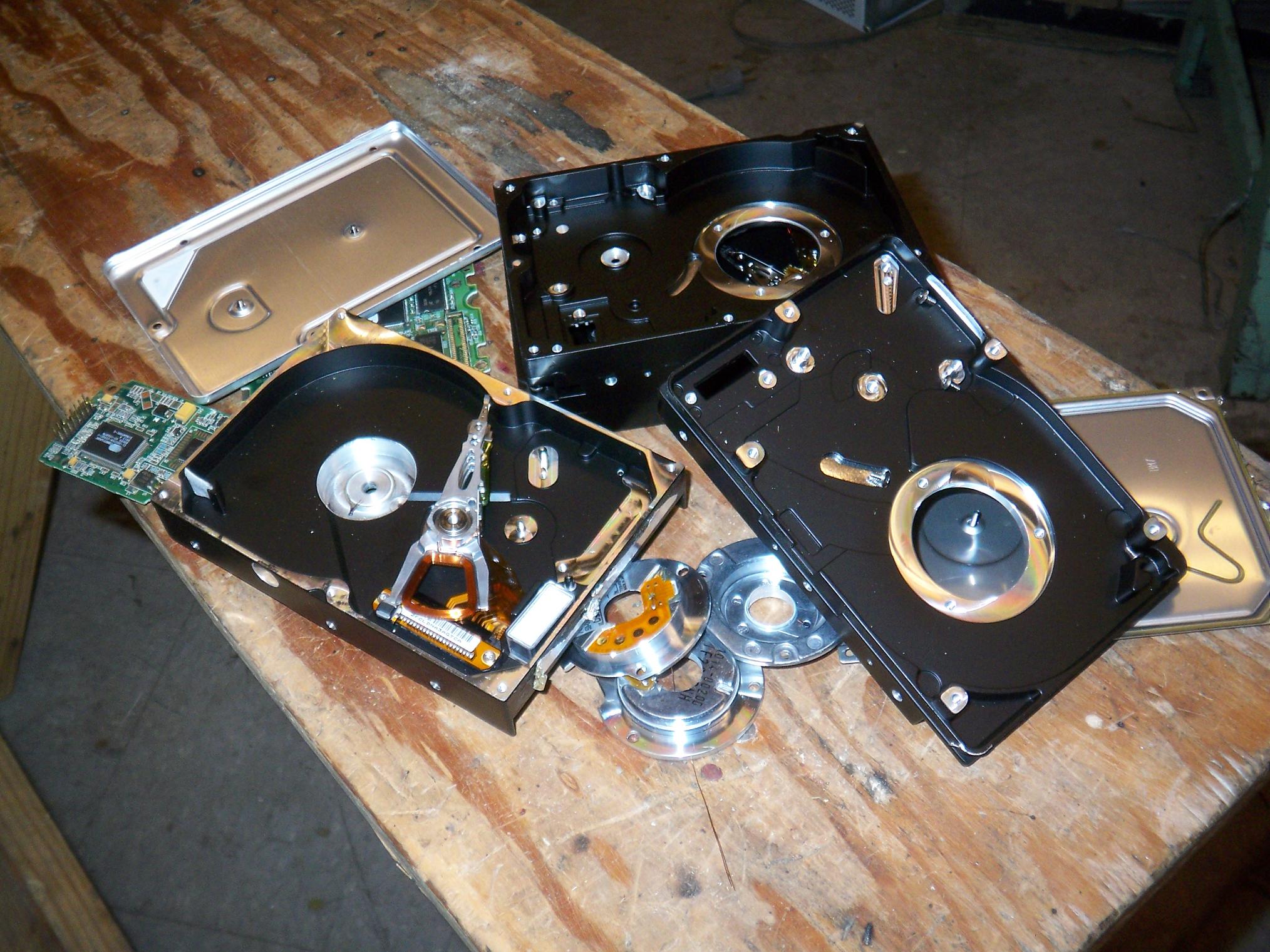
Result of the Night of Terror. The other MITERers were, of course, glad to act as parts vultures, stripping the discs, magnets, RW heads, and various random bearings and spacers. I wonder how many cents I can get if I recycle the casings.

Time to get down to business. Behold, the sketchiest sawing setup that has ever existed.
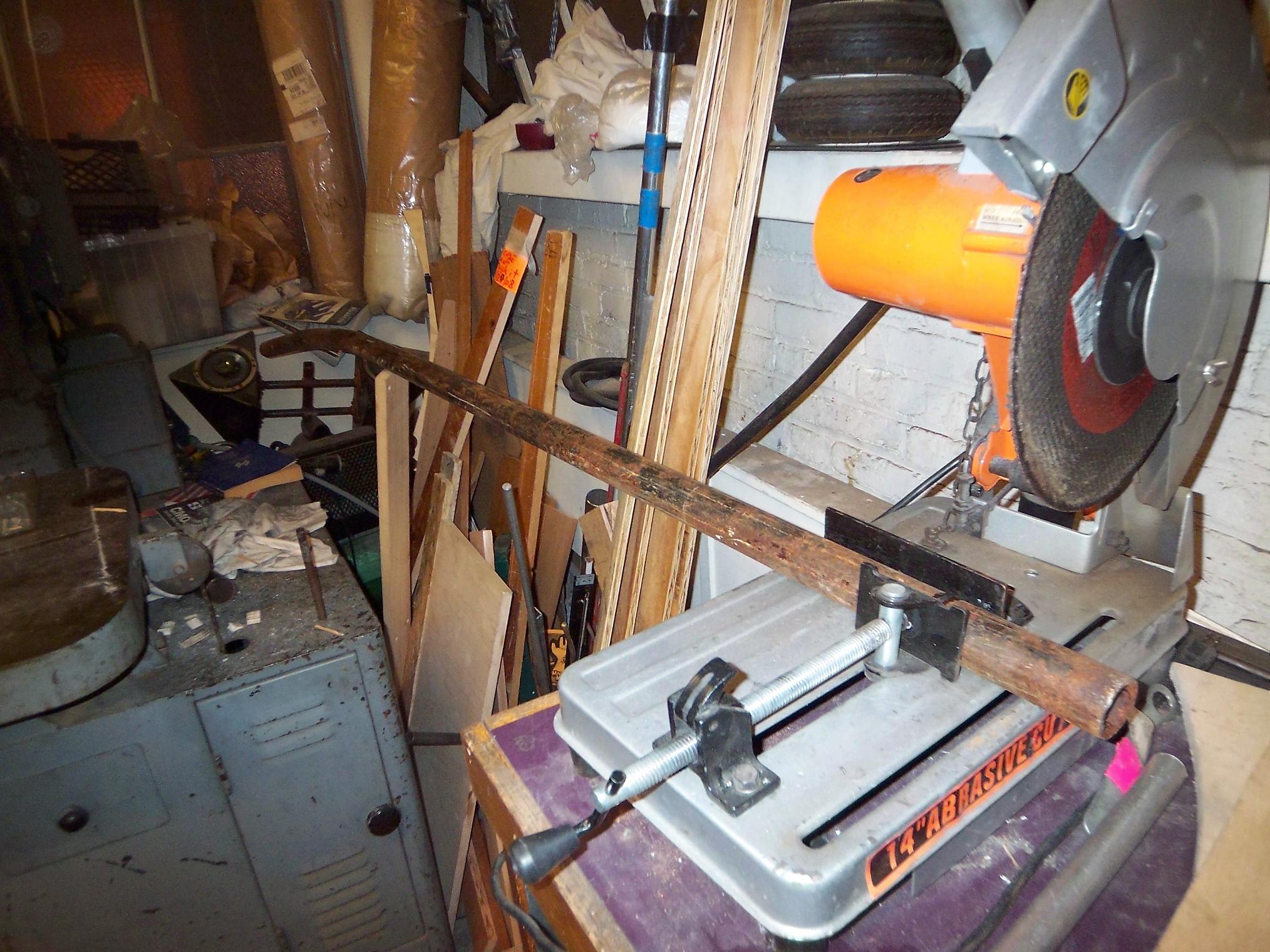
I needed a chunk off this 8 foot long, 1.6″ diameter steel pipe. There wasn’t really an easy way to handle it besides propping it up on the work table and using the abrasive saw.

Problem was, there wasn’t really a sawhorse or structure that could easily fit in the space provided. The solution was to prop it up with a wooden board and just hope nothing moves.

Nothing moved, but the effort proved fruitless as the inside of the steel pipe, when cleaned of rust, was around 1.3″ diameter. I need a 1.295″ ID on the magnet ring, and would rather trim outwards from a smaller pipe.

D’oh.
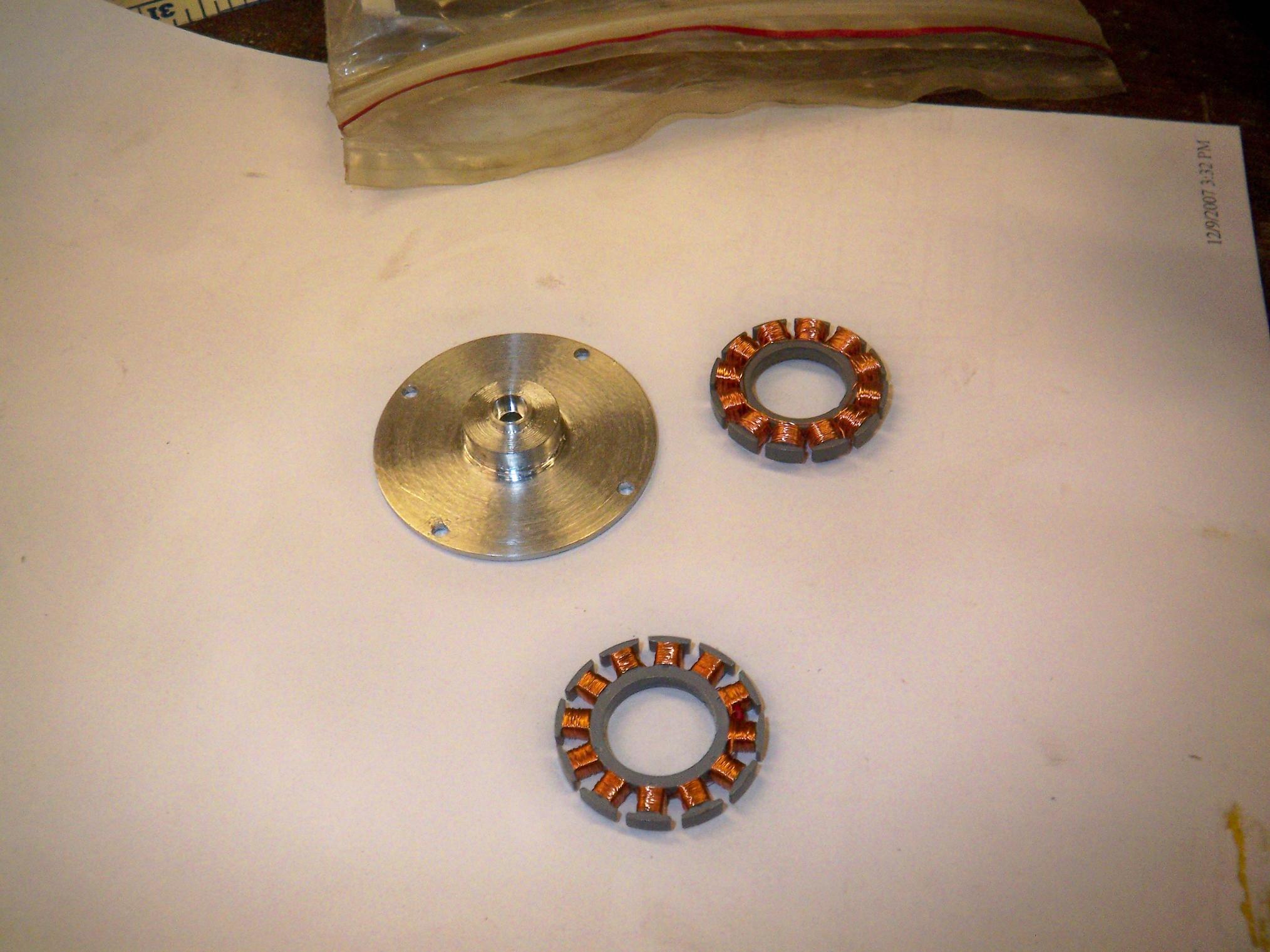
So the next thing to do was to start on the aluminum bits. Here’s the completed motor base. Or, rather, here’s a completed dummy motor base. It was a good practice run to get the quirks of manufacturing out, but ultimately there were some inaccuracies.

The MITERS lathe is well-known for being inconsistently inconsistent (consistently inconsistent would mean I’d be able to predict and offset appropriately to account for its behavior), and I had all sorts of weird things happen again, like the tailstock that points to any one of 5 constellations depending on where it is on the bed, how hard I crank the camlock, what bit I use, how I mount it in the chuck, how far out the tailstock ram is, and the phase of sunspots. And again, the toolpost proved troublesome – it’s awfully flexible for being a block of metal, and some times flexes slightly on cuts, which throws off the dimensions.

I might need to hit up one of the student shops for this application, which requires a bit of precision.
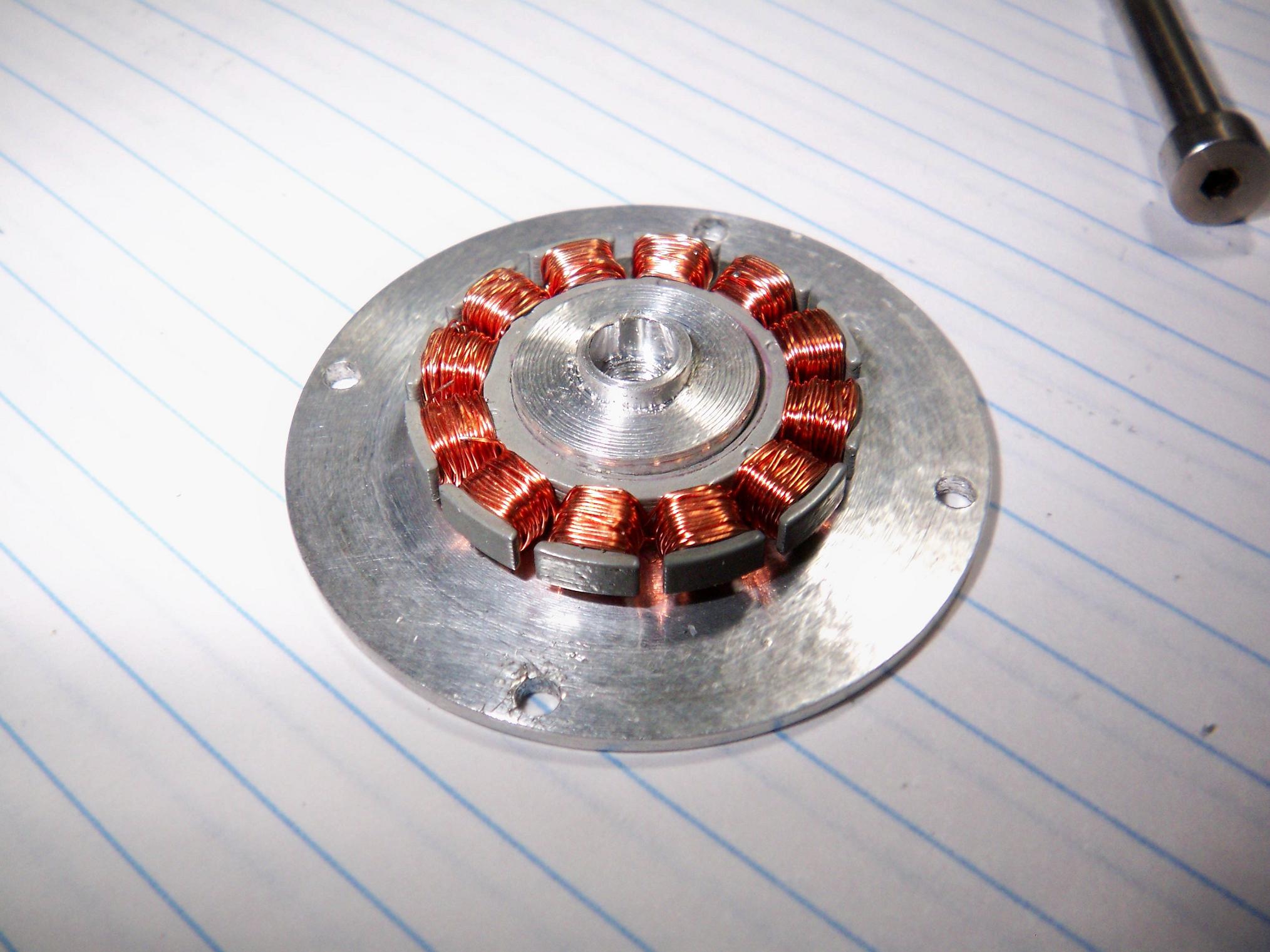
Assembled (with a stock ganked HDD stator). The stator is supposed be flush with the top of the stepped nub, but of course it’s 1.2mm too short to do so. This is actually not as bad as I make it out to be. The base, as it is, will make a good backup part, since there’s only a small amount of error on the OD and the depth of the center hole.

Overall, the test assembly confirms some of the hopes I had about fitting the motor can and maintaining space for the windings. There’s a fair amount of space to wind with.

More work to come!

Back to electric spinny things

A long time ago, I drew up a concept bot for NK5.0, but never got far with it. After MIT hit, I found myself focused less on the robots and more on… well, MIT. Now that summer and its associated nonproductivity is approaching, I have redone the bot in full, just like Pop Quiz. Lots of changes have been made which reflects what I learned over the year and what tools I have access to.

This is the old concept bot from July ’07.

It’s a radical departure from the current NK design. The most obvious feature is the large swinging weapon pod in the middle of the bot. This solves the invertability problem that NK has suffered from since the design inception. The drivetrain is symmetrical, and of similar layout to the current bot. It also uses the motor-in-disc design that I have been wanting to try.

There are several problems with this design. The chassis has too many parts, and rather poor support in the back. The weapon pod is very thick and large, and the disc motor itself is extremely “overbuilt”. The bot in this picture weighs 2.6 pounds without any internals, hardware, or covers. It’s not going to make weight.

Also, the “fully integrated” motor-disc design was going to be impossible to pull off. No technology that I have easy access to was going to cut those inside “rutts of magnet holding” on the blade bore. Wire EDM could manage it, but I don’t have access to such a thing. A waterjet would be too messy for the tolerances required.

So I set out over the week to redesign the bot so that it can actually be built.

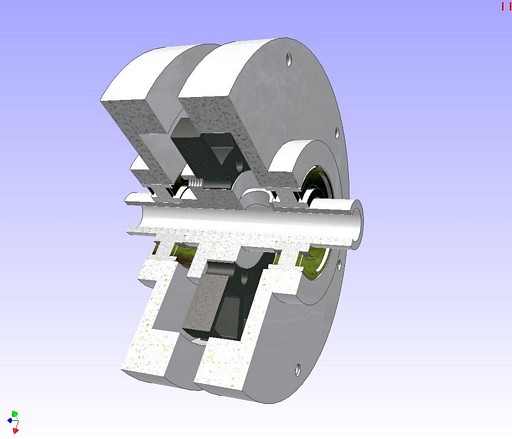
I found a convenient button on the Inventor toolbar that allowed a section view of the assembly. So here’s a cross-section of the old discmotor design. It’s about 1.25″ wide at the rim, and 2″ wide at the shaft, with massive 12mm bearings. The stator is also mounted using a real bona-fide hub using its bolt holes, and the wires exit through the hollow in the shaft. It weighs more than half a pound alone, and there are some material properties I forgot to set (and Inventor will not let me reset to find out…)

I threw this out. It’s simply too overbuilt, but would make a nice dual-blade setup for a bigger bot, one per side.

This is the new motor design.

It’s one inch wide at the shaft, and weighs about 6 ounces. In essence, it’s a scaled down version of the scooter wheelmotor. This is quite reasonable when you think about it, since I could strap a big pointy thing to the wheelmotor and have it be a great weapon.

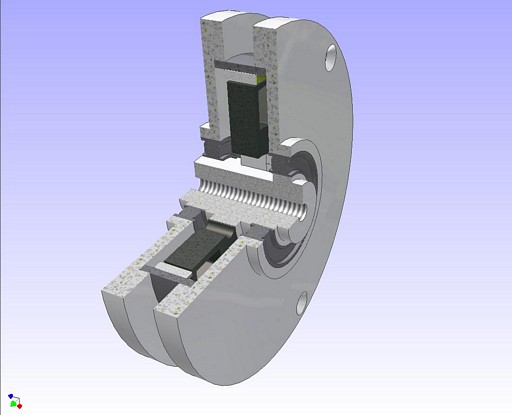
Here’s the cross section of the new motor. Major differences include a real motor can, sandwiched betwen the side plates, just like the wheelmotor. The stator hub was removed and replaced with a one-piece shafthub assembly which presses into the stator. I decided that in this size of motor it wasn’t worth giving the stator a bolted-down hub. Hell, the wheelmotor has a press-fit-and-Loctite hub. Another major difference is that the wires exit through an open space between a flat in the shaft and the bearing inner race. The bearings are larger in diameter, but narrower in profile and thinner radially. They are the same bearings used in the wheelmotor – I figure that if it can handle bunnyhops off sidewalk curbs and constant banging on cobblestone surfaces, a 3lber shouldn’t be much worse.

Overall, the construction is simpler and material isn’t overused. The motor is made modular and not integrated into the disc.

The whole discmotor. I eliminated the many large holes in the previous blade in favor of only three smaller ones. The hub area of the other blade design had huge stress risers in the form of large bolt holes in the inner ring. This has been replaced by three spoke-area holes, each much smaller. The main means of power transmission will be the clamping pressure from these three screws holding the side plates together as well as the screws themselves acting as shear pins.

Here’s hoping they don’t actually shear. The motor doesn’t have nearly as much inertia as the blade, so I’m not too concerned.

Next was chassis and drivetrain design. I wanted to retain the layout of the drive motors as well as 4 wheel drive. The back “legs” of NK have been shortened, and I might even eliminate them entirely (such that the rear wheels are within the rectangle defined by the main body. One big change is that the shortening of the legs allowed me to make the whole back end from one piece of metal. No funky bolt holes to line up, less pieces to cut and make.

The front and rear of this design are angled at 75 degrees. Although this is far less than the 45 degree slope of the current NK, I don’t think it will be an issue since NK shouldn’t be pushing anyway… Overall, the design is more compact because of the straighter sides.

Mostly done. I redesigned the weapon cage also, to make more effective use of less material. The weapon is set further back in the body to increase handling (The further out a big weapon is from the rotational axis of the bot, the harder it is to swing it around. The cage was reduced to 1/8″ aluminum (or titanium!) that is bolted together with standoffs at the ends as well as solidly attached to the motor. This is much more stable than simply attaching the whole thing by the shaft of the motor. The “feelers” on the end are taller in profile for more stiffness.

Closed up. The new look for 2008 and 2009 is carbon fiber and raw metal. I’ll be moving away from UHMW for primary external structure use because it is simply not durable enough. UHMW is great for absorbing shocks and flaking off on blade impacts (as TB demonstrated handily) but I don’t feel like rebuilding the frame every time.

There are a few quirks that you might notice. First, the bot’s asymmetrical when inverted. I don’t consider this an issue as long as it can move and I can wing it into something and flip it back over. And second, the blade is optimized for spinning upwards and would suck running the other way. This is, of course, something that can be easily solved by designing a bidirectional blade. Overall, movement is more critical when the bot is inverted.

Prospective parts for this bot include a 1200 to 1400mAh, 3S lithium battery (which ALL seem to be out of stock at United Hobbies), and the retainment of the Barello ANT150 which has served all versions of NK since 2.0! I also intend to keep the modified 25mm gearboxes that give the bot incredible speed and maneuverability for a weapon platform (NK’s top speed is around four feet per second). The gearboxes themselves are well-trashed and I will get replacements, but the motors are an odd size (Mabuchi 370 frame, commonly called “speed 300” by the R/C world) and I have yet to find them cheap and surplus, only retail for $8 per motor.

When you have multiple bots of a generation designed…

This is an overview of what the insect fleet will be, hopefully by the time Robot Battles and Dragon Con rolls around.

Let’s see if I can actually afford these build these!

Bot on.